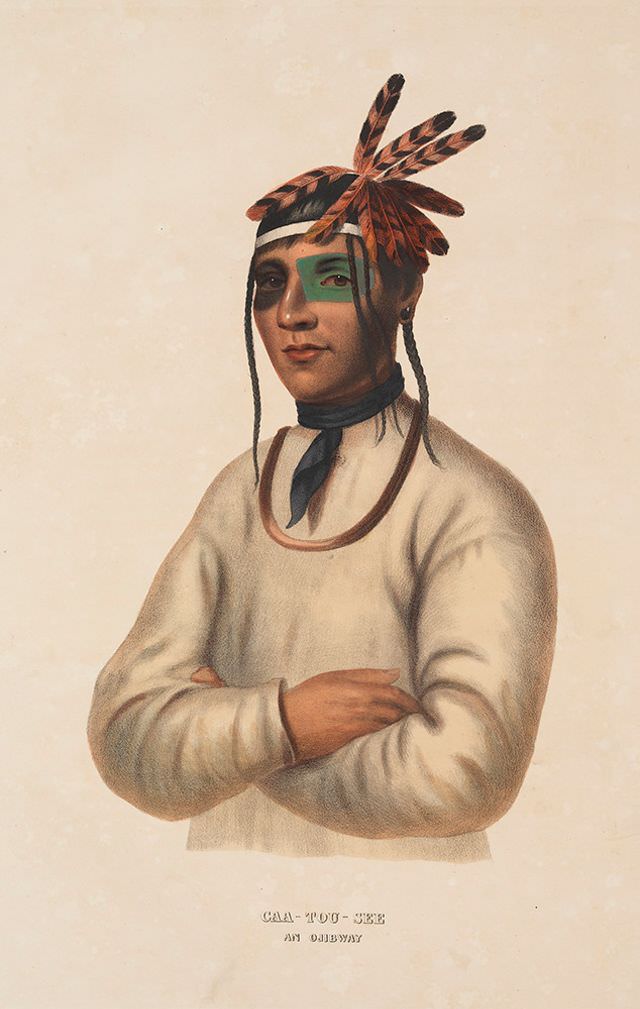
Caa-Tou-See appears in a carefully rendered portrait that balances intimacy with formality, presenting an Ojibway individual with arms folded and gaze turned slightly to the side. A feathered headdress crowns the headband, while long braids frame the face, and a vivid patch of green pigment around one eye draws attention to the sitter’s presence and self-presentation. The plain, light background keeps the focus on expression, clothing, and adornment, allowing viewers to study details without distraction.
Beneath the figure, the printed caption “CAA-TOU-SEE” and “AN OJIBWAY” signals how the artwork was meant to be read by its original audience—through a name and a generalized label that often stood in for a much richer personal and community identity. The clothing—a light shirt and a dark neckerchief—suggests a moment of cultural crossroads, where Indigenous style and introduced materials could meet in a single image. Portraits like this were frequently circulated as “artworks,” shaping how distant readers imagined Native life, even as they flattened complex realities into tidy categories.
For modern readers and researchers, this historical portrait invites a slower look and a more careful set of questions: what choices did the sitter make about dress, hairstyle, and paint, and what might an artist or publisher have emphasized for effect? The composition offers valuable visual cues for anyone interested in Ojibway history, Indigenous portraiture, and early printed representations of Native peoples. As part of a WordPress archive of historical images, it works both as a striking work of art and as a reminder to approach such depictions with context, respect, and curiosity.