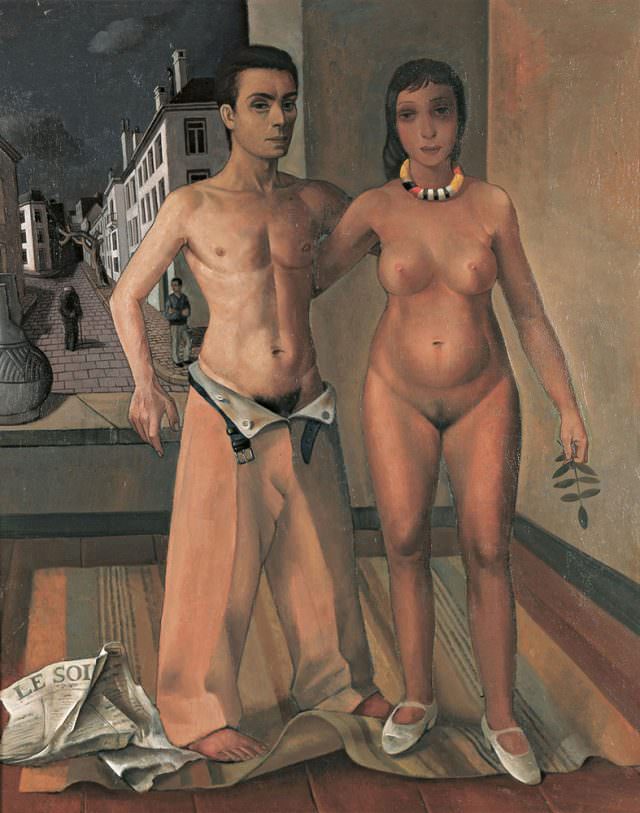
Felix and Felka, 1943 places two nude figures at the threshold of an interior, their bodies rendered with a cool stillness that feels both intimate and uneasy. He stands partly clothed, belt and trousers slipping low, while she faces forward with a calm, direct gaze, a striped necklace and pale shoes adding small flashes of modern life. The careful modeling of skin tones against the plain wall makes their presence unavoidable, as if the room itself has become a stage for vulnerability.
Behind them, a window opens onto a quiet street lined with tall buildings, the distant pedestrians reduced to small silhouettes beneath a darkening sky. That outside world—orderly, watchful, and slightly ominous—contrasts with the private exposure in the foreground, and the composition tightens the sense of being seen. A folded newspaper on the floor, with the visible masthead “LE SOIR,” anchors the scene in everyday wartime routine without stating more than the painting is willing to reveal.
As an artwork tied to 1943, this piece reads like a psychological document as much as a figurative study, balancing tenderness and tension in a single frame. The near-sculptural poses, the spare furnishings, and the stark divide between interior and street invite viewers to consider privacy, surveillance, and the fragility of normalcy. For readers searching for “Felix and Felka 1943” or historical wartime art, the image offers a memorable example of how a simple room and two human bodies can carry the weight of an era.