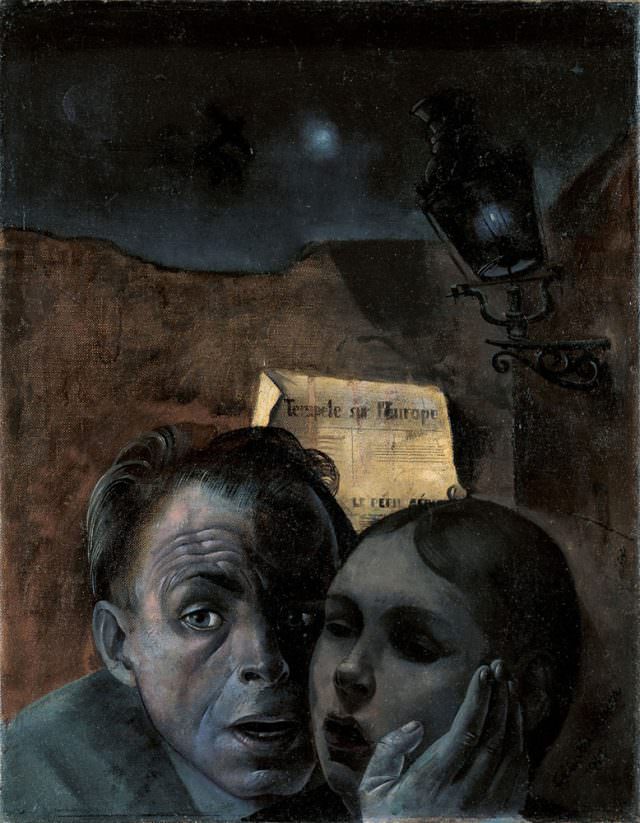
A close, intimate pairing dominates the frame: an older man with a tired, half-lit face and a younger woman leaning in, her cheek resting on her hand as if caught between listening and dreaming. Their expressions feel deliberately staged—part portrait, part performance—suggesting a relationship that is both familial and theatrical, perfectly in tune with the title “The artist and his niece, Angst, 1941.” The muted palette and heavy shadows lend the scene a claustrophobic quiet, where the viewer is pulled in close enough to notice every crease, contour, and painted nuance.
Behind them, a crumpled newspaper emerges from the gloom, its French masthead “L’Oeuvre” readable, anchoring the work in a world of public events and private anxieties. The background is sparse but telling: a wall washed in darkness, a wrought-iron bracket or lamp silhouette, and a small, cold glint of light that makes the room feel late and watchful. Rather than offering a clear narrative, the composition builds mood—an atmosphere of wartime tension and psychological unrest that the word “Angst” makes impossible to ignore.
For a WordPress post on historical art and photography, this piece works beautifully as a meditation on how artists recorded emotion when ordinary life felt unstable. It invites keywords like “1941 portrait,” “artist and niece,” “Angst,” “wartime atmosphere,” and “European newspaper” without forcing conclusions the image itself doesn’t confirm. The result is a haunting, story-rich artwork that lingers—less a straightforward likeness than a study in proximity, fear, and the complicated tenderness of looking at someone you cannot fully protect.