Category: Civil Wars
Explore the human side of civil wars through authentic historical photographs. Witness the struggles, courage, and consequences of divided nations.
These images document key events and personal moments that shaped political and social transformations around the world.
-
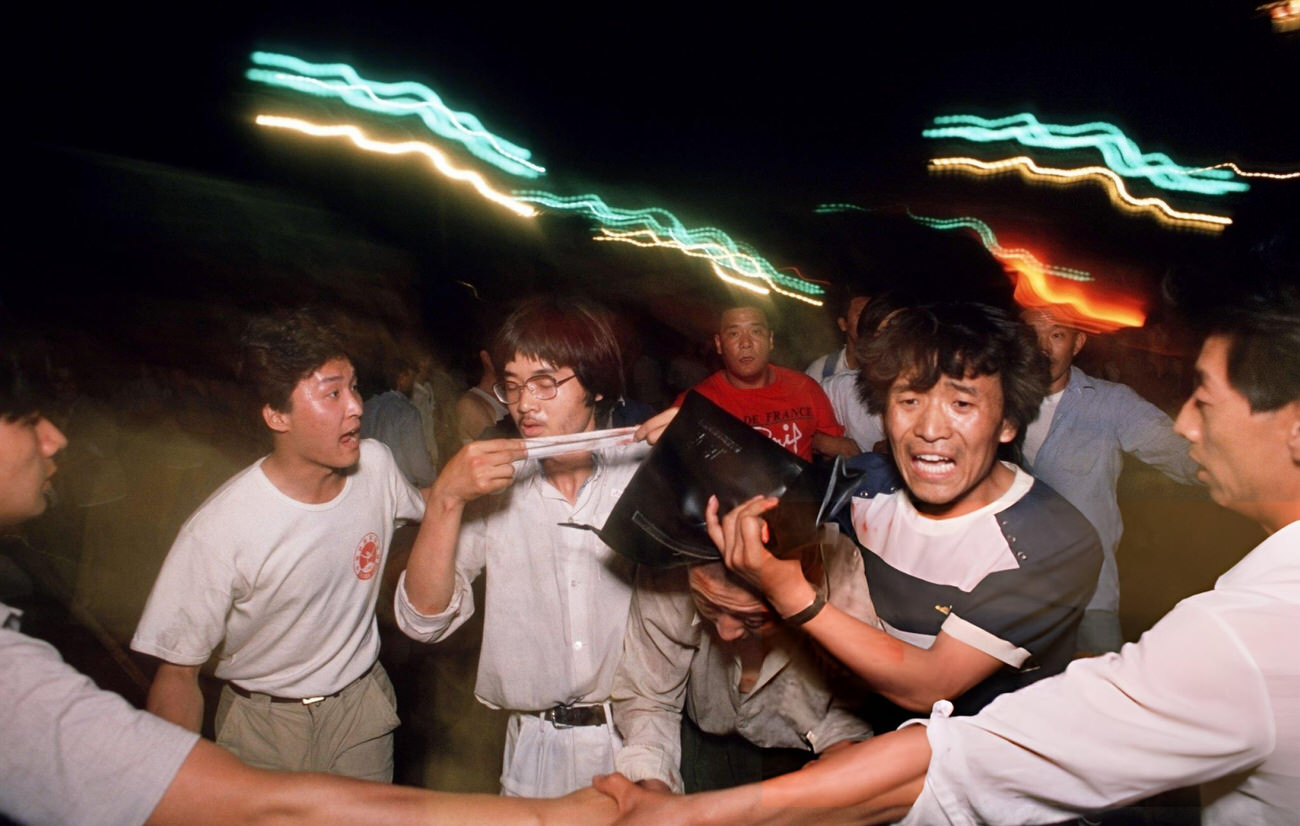
#36 Pro-democracy demonstrators come to the aid of a wounded soldier, 1989.
Nighttime chaos blurs into streaks of neon as a tight knot of pro-democracy demonstrators rushes forward, faces tense and mouths open mid-shout. In the center, a wounded soldier slumps as civilians crowd close, bracing him with their bodies while one man presses a strip of cloth toward his face. The motion in the frame—half smear,…
-

#52 Chinese Army tanks block an overpass on Changan Avenue leading to Tiananmen Square, 1989.
Armored tanks sit nose-to-tail across an overpass on Changan Avenue, their long barrels angled over an emptied roadway that should have been a main artery into Tiananmen Square. Painted turret numbers and red stars stand out against worn green metal, while soldiers in uniform move between the vehicles, turning a public thoroughfare into a controlled…
-

#68 The protest movement of students that started seven weeks ago in Tiananmen Square, 1989.
Urgency floods the frame as a cluster of young people surge forward around a bicycle cart, transforming an everyday vehicle into an improvised stretcher. One man gestures ahead, mouth open as if calling directions, while others brace the load with outstretched hands; the scene feels less like a march than a frantic evacuation. In the…
-
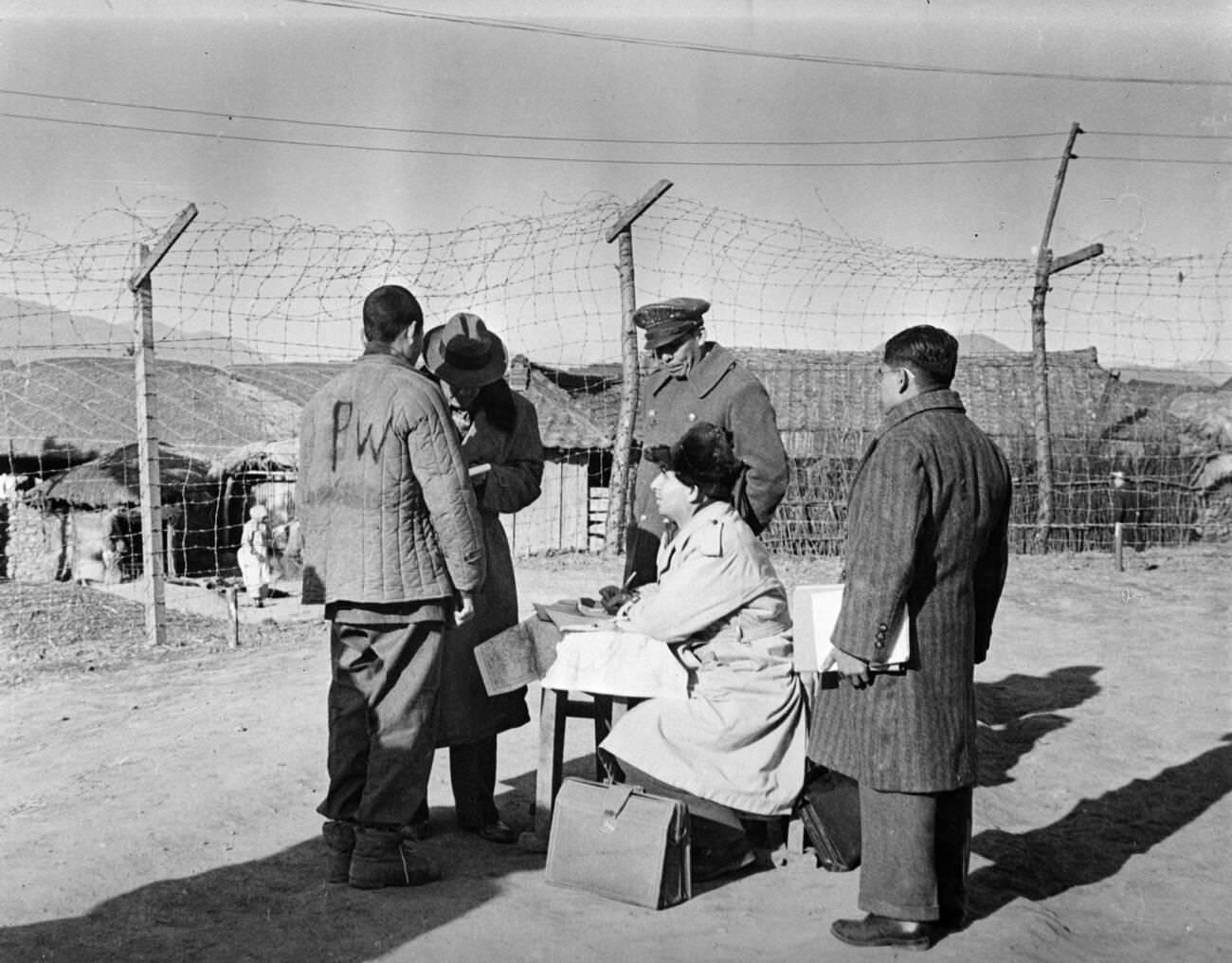
#9 Interrogation of Chinese prisoners of war during the Korean War, 1950s.
Barbed wire and open sky frame a tense, procedural moment from the Korean War of the 1950s, where a Chinese prisoner of war stands in a camp enclosure marked “P.W.” on his jacket. A small table becomes the center of gravity: papers spread, a briefcase on the ground, and officials in coats and caps leaning…
-

#25 Korean War, Korean War Orphan, 1951.
A small boy stands alone in the middle of a wide, dusty street, his hands tucked into oversized trousers that bunch around his shoes. A tilted cap sits on his head as if borrowed, and his steady gaze meets the camera with a mix of fatigue and hard-won composure. Behind him, wooden storefronts, utility poles,…
-

#41 Korean War- African-American Marines, 1950s.
Under a pale sky and among shattered trees, African-American Marines hunker down behind a rough earthwork, their helmets and packs scattered across a scarred slope. Some lie prone with rifles close at hand while others rise to scan the ridge, turning the scene into a study of vigilance and exhaustion. The terrain—pocked, stripped, and uneven—speaks…
-

#57 KOREAN WAR US Air Force B-29 Superfortresses on a daylight bombing raid, 1951.
High above a broken landscape of cloud and haze, a formation of U.S. Air Force B-29 Superfortresses presses forward in daylight, their broad wings and tail markings stark against the sky. Beneath them, a trail of falling bombs stipples the frame, each dark silhouette a frozen instant in a much longer descent. The photo’s grain…
-

#73 Korean War, Sailors Prepare for Inspection, 1953.
Inside a cramped, utilitarian barracks space, a circle of sailors bends over boots, rags, and tins of polish, each man intent on coaxing a mirror shine from well-worn leather. The title places the scene in 1953 during the Korean War, and the mood fits that late-war tension: quiet, focused, almost ritualistic preparation. Folding chairs crowd…
-
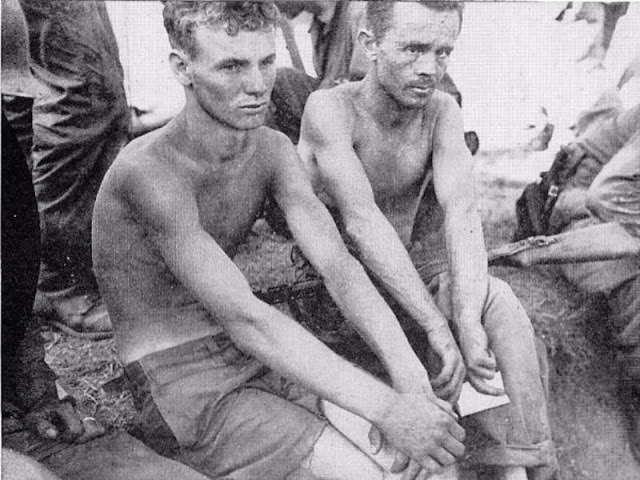
#89 Two Hill 303 survivors after being rescued by American units, 1950.
Bare-chested and hollow-eyed, two young soldiers sit close together on rough ground, their arms drawn in and their hands clasped as if to steady themselves. Dirt streaks their skin and their trousers hang loose, suggesting days of exhaustion, exposure, and hunger. Around them, blurred figures and a jumble of gear hint at the immediate aftermath…
-

#105 Following World War II, the Korean peninsula was divided along the 38th parallel, with the creation of communist-backed North Korea and the anti-communist Republic of South Korea. On June 25, 1950, North invaded South, leading to the outbreak of the Korean War.
A roadside sign dominates the frame with blunt, bureaucratic clarity: “YOU ARE NOW CROSSING” the “38th PARALLEL,” a line that became far more than a cartographic marker in the aftermath of World War II. The stark lettering and military abbreviations hint at authority and control, while the hazy hills in the distance suggest how ordinary…