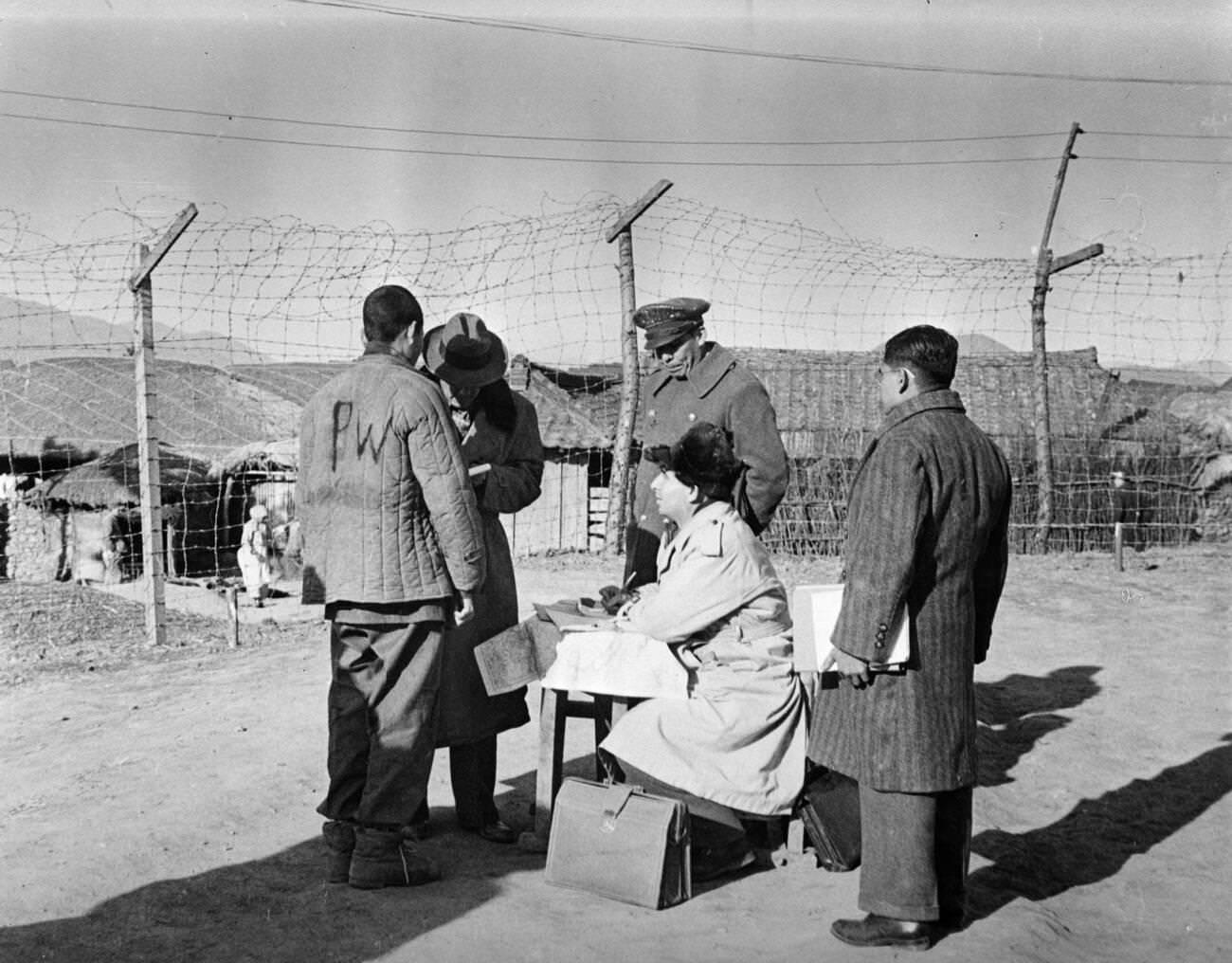
Barbed wire and open sky frame a tense, procedural moment from the Korean War of the 1950s, where a Chinese prisoner of war stands in a camp enclosure marked “P.W.” on his jacket. A small table becomes the center of gravity: papers spread, a briefcase on the ground, and officials in coats and caps leaning in to record answers. The spare landscape beyond the fence—low hills and rough ground—underscores how far this scene sits from any notion of comfort or normal civic order.
Interrogation in wartime was rarely dramatic in the Hollywood sense; it often looked like this—administrative, cold, and relentlessly methodical. The body language suggests a controlled encounter in which the prisoner is surrounded by authority and documentation, with note-taking and translation likely shaping every exchanged word. Such images offer a stark window into how armies tried to convert captured soldiers into information, and how captivity reduced individuals to identifiers, statements, and forms.
For readers searching Korean War history photos, POW camp imagery, or documentation of Chinese prisoners during the conflict, this photograph provides a grounded view of the war’s bureaucratic underside. It invites questions about rules of captivity, intelligence gathering, and the human consequences of a conflict often summarized by front lines and ceasefire negotiations. Seen today, the scene is both evidence and reminder: behind the larger headlines of the 1950s Korean War were countless quiet encounters where power, survival, and record-keeping met across a table.