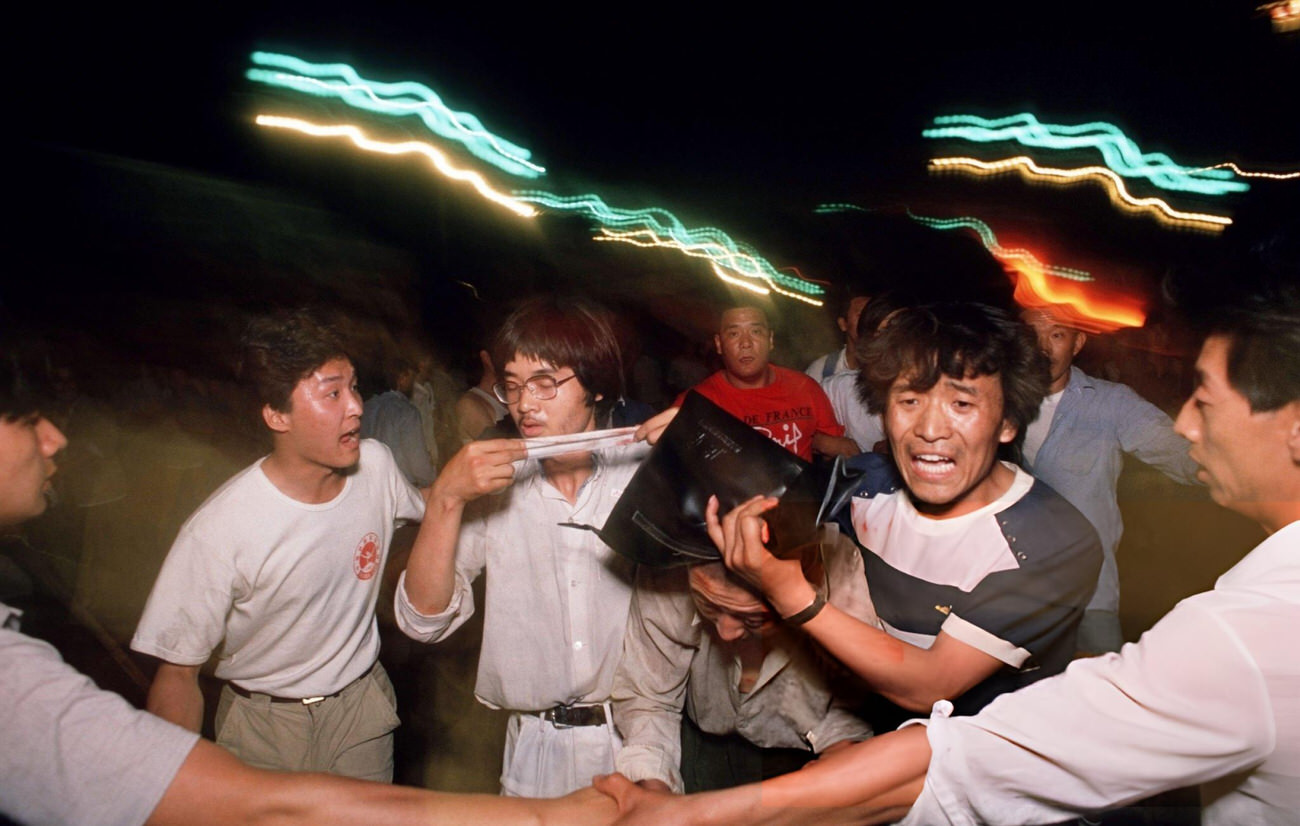
Nighttime chaos blurs into streaks of neon as a tight knot of pro-democracy demonstrators rushes forward, faces tense and mouths open mid-shout. In the center, a wounded soldier slumps as civilians crowd close, bracing him with their bodies while one man presses a strip of cloth toward his face. The motion in the frame—half smear, half snapshot—reads like adrenaline made visible, suggesting urgency rather than choreography.
What stands out is the refusal to reduce anyone to a single role: protester, soldier, victim, enemy. Hands reach in from every side, not to strike but to steady, lift, and shield, turning an instant of street violence into a fleeting act of care. The title’s promise is borne out in the details—improvised first aid, frantic coordination, and the raw human instinct to preserve life even as a political struggle erupts around them.
As a historical photo from 1989, this scene belongs to a year synonymous with popular movements and crackdowns, when demands for reform collided with state power across multiple societies. For readers searching for images of pro-democracy protests, civil conflict, and the lived experience of unrest, the photograph offers something rarer than spectacle: a moral complication captured in motion. It reminds us that the history of civil wars and political upheaval is also written in small, immediate decisions—who stops, who helps, and what it costs to do so.