Category: Colorization
See history come to life with colorized photographs of the past. From wars to daily life, these restored images bridge time with emotion and realism.
Each colorized photo revives forgotten stories and gives a fresh perspective on iconic historical moments.
-
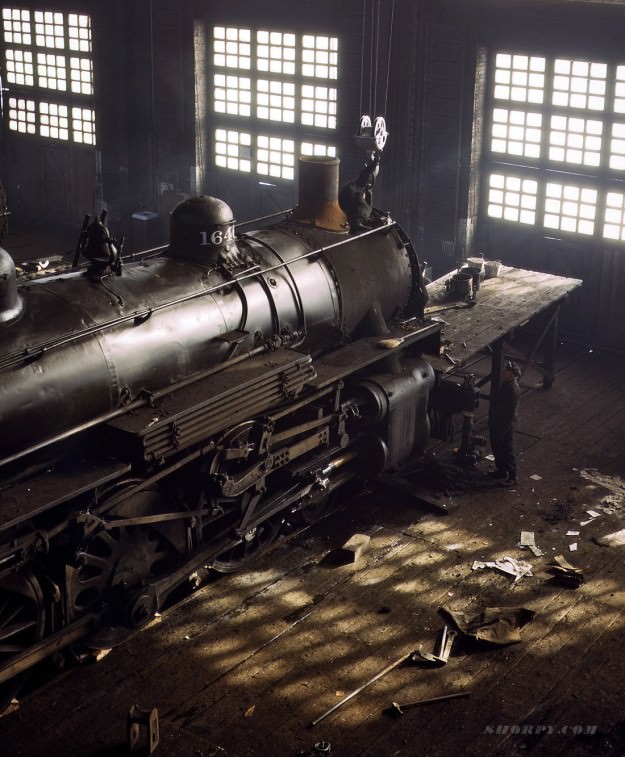
#8 40th Street Shop, Chicago & Northwestern R.R. December 1942. 4×5 Kodachrome transparency by Jack Delano. Back to the days of the blacksmith: The only tools seen here are two hammers, a wrench and a broom.
Warm winter light pours through tall, gridded windows at the 40th Street Shop of the Chicago & Northwestern R.R., turning soot and steam into a hazy glow around a waiting locomotive. The Kodachrome color gives the scene a lived-in realism—dark metal skin, dulled paint, and the quiet sheen of parts that have been handled and…
-
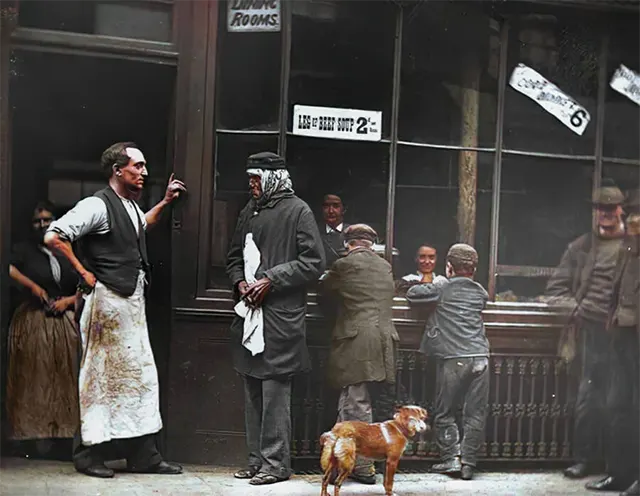
#1 A pub frequented by convicts and “ticket-of-leave” men, 1890s.
Outside the pub’s dark frontage, men linger in the doorway and along the pavement, the scene rendered newly vivid through careful colorization. A barman or porter in a stained white apron leans with the easy authority of someone who has spent years minding the threshold, while a bundled figure with a cloth in hand pauses…
-
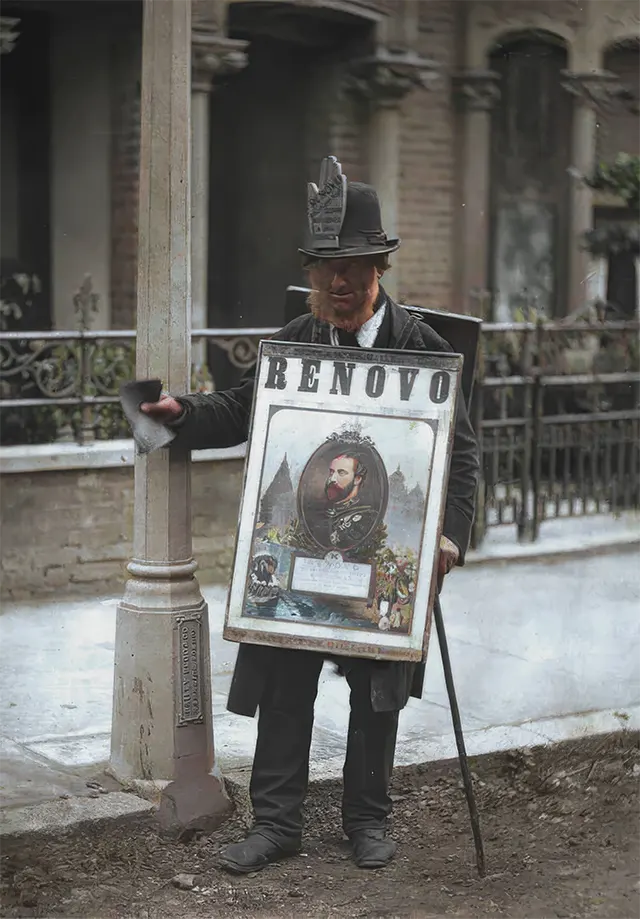
#17 A London boardman distributes flyers, 1890s.
Lean and weathered, a London boardman stands at the edge of the pavement with a stout walking stick and a bundle of handbills ready to pass along. The colorization brings forward the textures of his working clothes and the familiar silhouette of a bowler hat, placing him in the everyday street life of the 1890s…
-
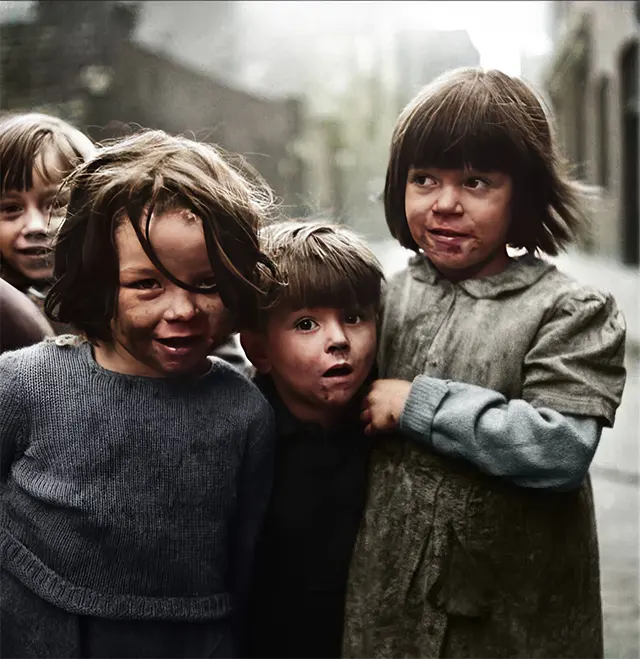
#33 Poor children of the Stepney slum, 1895.
Grimy faces and wary half-smiles crowd the foreground as several children press together on a narrow street, their expressions swinging between curiosity and exhaustion. The colorization brings out the lived-in textures—mud on cheeks, frayed knitwear, and the heavy, dull tones of clothing that looks made to last through hard use rather than to charm. Behind…
-

#8 An unidentified dead man in New York City. Circa early 20th century.
A narrow stairwell in New York City becomes a grim stage in this early 20th-century scene, where an unidentified man lies sprawled on the steps in a rumpled suit and loosened collar. The colorization brings an unsettling immediacy: dark wood paneling closes in on both sides, and a patterned tile landing above frames the body…
-

#24 The burnt body of gangster Irving Feinstein, who was set on fire by Murder Inc. killers Harry Strauss and Martin Goldstein and left exposed in a lot in New York City, 1938.
Under the flat daylight of an open lot, a scorched body lies curled in the grass, the ground around it darkened into an irregular burn scar. A lone shoe and scraps of debris punctuate the scene, while a brick wall and a parked car sit at the edge of the frame—ordinary city backdrops made unsettling…
-

#9 Vera Crichton at the Sydney Women’s Reformatory in 1924. Was arrested after being caught conspiring to procure a miscarriage.
A stark studio-style intake portrait introduces Vera Crichton at the Sydney Women’s Reformatory in 1924, her name and a string of institutional markings chalked above her head like a caption written by authority. The careful colorization draws you into the small, human details—pale blue eyes fixed on the lens, a tired set to the mouth,…
-
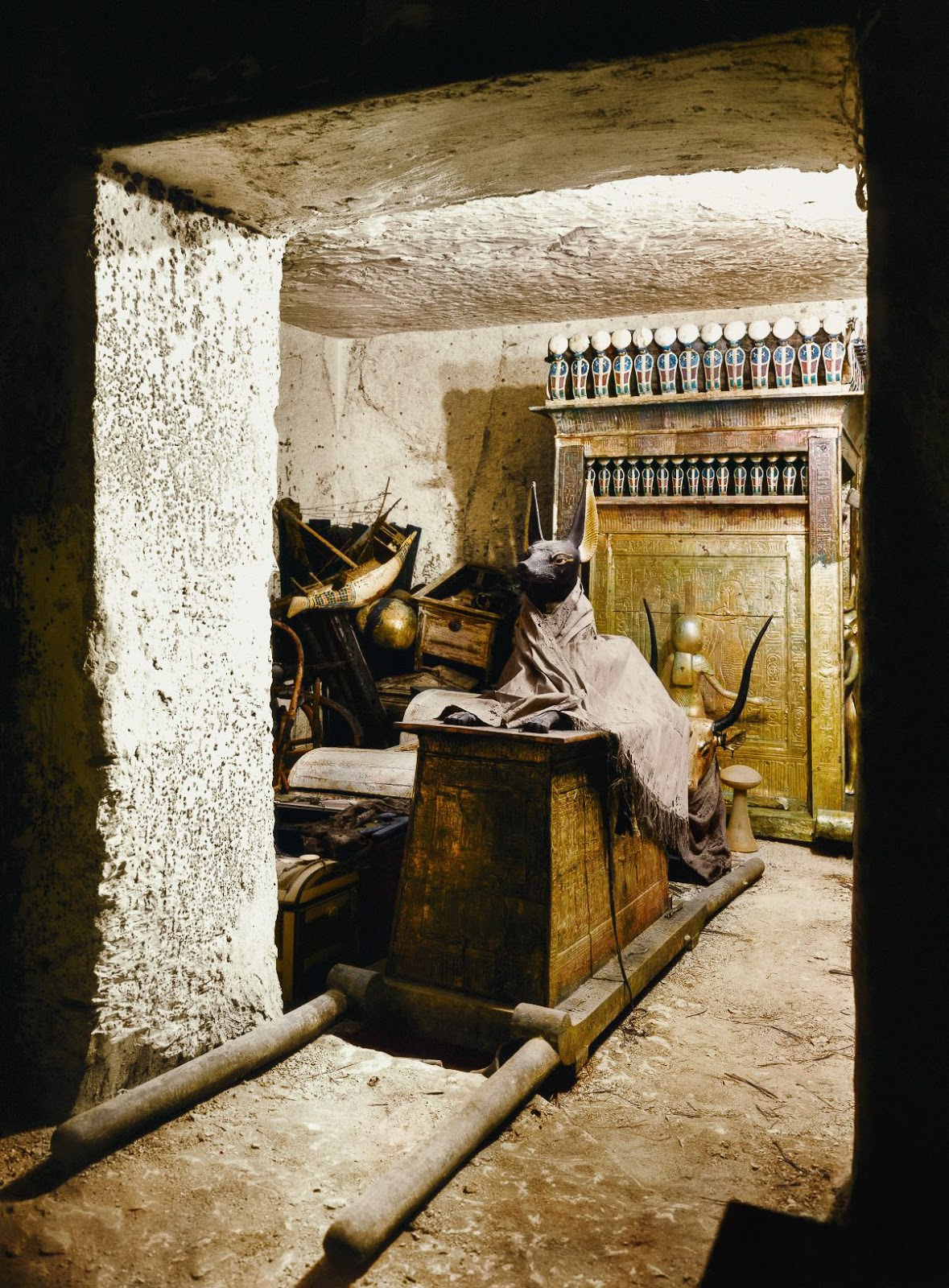
#15 The Anubis shrine (Carter no. 261) on the threshold of the Treasury viewed from the Burial Chamber.
At the narrow threshold between the Burial Chamber and the Treasury stands the famed Anubis shrine, catalogued as Carter no. 261, its jackal-headed guardian poised in watchful silence. The colorization draws the eye to the deep blacks of the figure, the muted linen drape over its back, and the warm, dusty tones of the tomb’s…
-
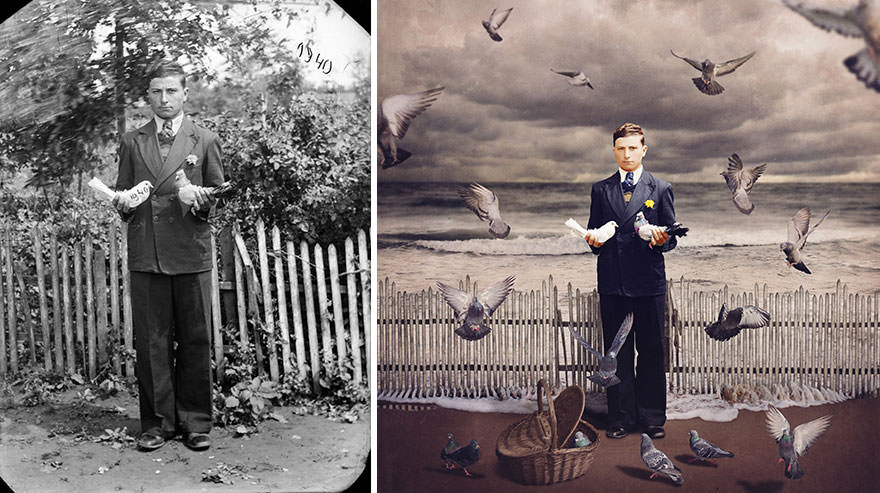
#10 Photographer Recolor Historic Glass-Plate Photos With His Conceptual And Artistic Imagination #10 Color
A young man stands stiffly in a formal suit, a small yellow boutonniere bright against the dark fabric as he cradles a pair of pale birds in his hands. Behind him, a simple wooden picket fence and dense foliage suggest an ordinary yard, yet the pose feels ceremonial—part portrait, part quiet statement about care, possession,…
-
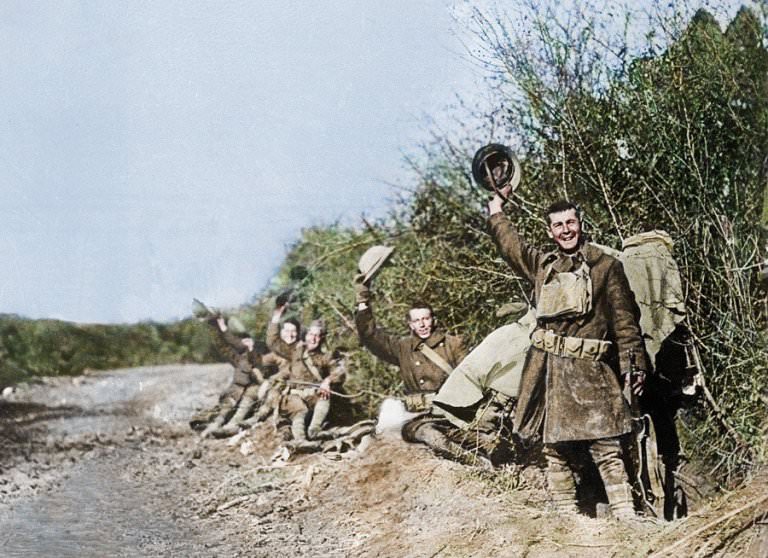
#6 A group of troops wave their hats as they pose for a camera on the edge of a road next to some hedgerows on Armistice Day.
A roadside bank and tangled hedgerows become an impromptu stage as a line of troops lean back, grin, and lift their hats high for the camera. Mud and ruts edge the road, and the men’s heavy coats and field gear—packs, belts, and worn boots—hint at long days outdoors even as their faces brighten in a…