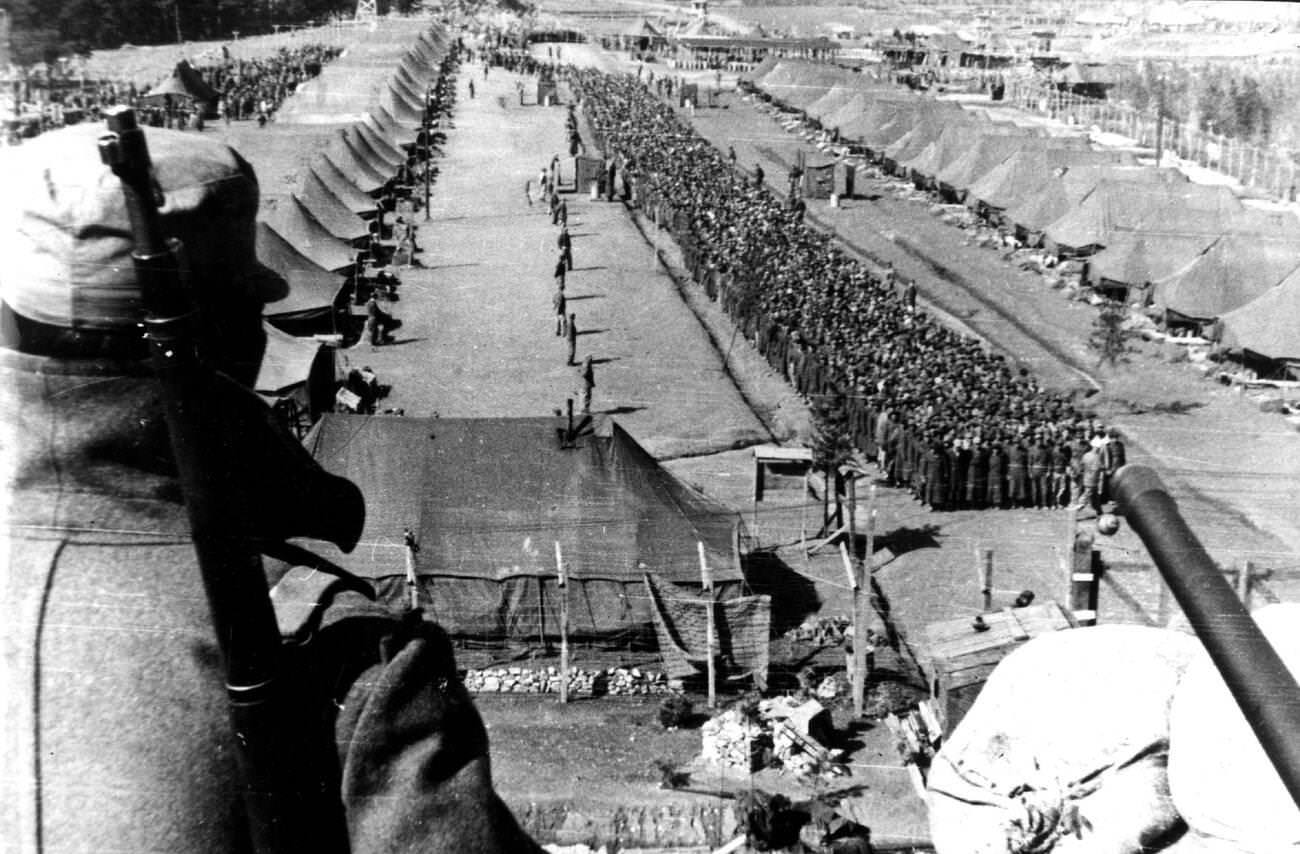
Seen from an elevated vantage point, the scene stretches into the distance: long rows of canvas tents form a temporary city while hundreds—perhaps thousands—of people stand packed into orderly lines along the camp’s central roadway. In the foreground, a soldier’s helmeted profile and slung rifle anchor the frame, reminding the viewer that the Korean War of the 1950s was lived at close range by individuals tasked with guarding, organizing, and surviving. The stark geometry of tents and queues gives the landscape a disciplined, almost industrial rhythm.
What draws the eye is the sheer scale of human movement and administration suggested here, a hallmark of mid‑century conflict in Korea where armies and civilians alike were swept into systems of transport, screening, supply, and shelter. The crowd’s heavy coats and the bare, dusty ground hint at hardship and uncertainty, whether these lines represent troops assembling, displaced civilians awaiting aid, or people being processed through a controlled camp environment. Without a clearly visible sign or caption, the photograph resists simple labels, yet it speaks plainly about logistics and human endurance under wartime pressure.
For readers exploring Korean War history, this image offers more than battlefield drama; it captures the infrastructure of war—tents, roads, guards, and the waiting that defined so many lives in the 1950s. The composition underscores how conflict creates spaces where order is imposed on chaos, and where time is measured in lines, inspections, and the next instruction. As a historical photo, it invites reflection on the civil and military dimensions of war, and on the countless stories contained within a single, crowded frame.