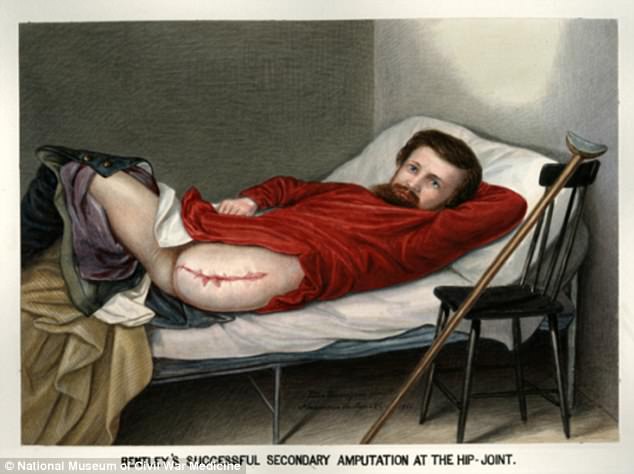
Reclining on a narrow cot, Private George W. Lemon meets the viewer’s gaze with a steadiness that belies the ordeal implied by the title. The composition draws attention to his injured leg, where a long stitched incision runs across the exposed thigh, while his uniform trousers and undergarments are pushed aside to reveal the aftermath of battlefield trauma. A cane or crutch leans against a simple chair nearby, quietly emphasizing the slow, uncertain work of recovery for a wounded Civil War soldier.
Color and detail give the scene an almost clinical clarity, suggesting the kind of medical documentation that emerged alongside wartime surgery and hospital care. The visible sutures and careful positioning of the body on clean bedding underline both the risks of infection and the evolving practices of 19th-century medicine, when survival often depended on prompt treatment and a bit of luck. Even without a crowded ward in view, the spare furnishings hint at the institutional world of military hospitals that expanded dramatically during the 1864 campaigns.
For readers searching for Civil War history, the Battle of the Wilderness, or the human cost behind major engagements, Lemon’s portrait offers a direct, personal entry point. It reminds us that the war’s story was not only told in troop movements and commanders’ decisions, but also in wounded men enduring pain, waiting, and rehabilitation far from the fighting. As a historical image, it stands as both a record of injury and an enduring testament to the lived experience of soldiers caught in one of the conflict’s grimmest battles.