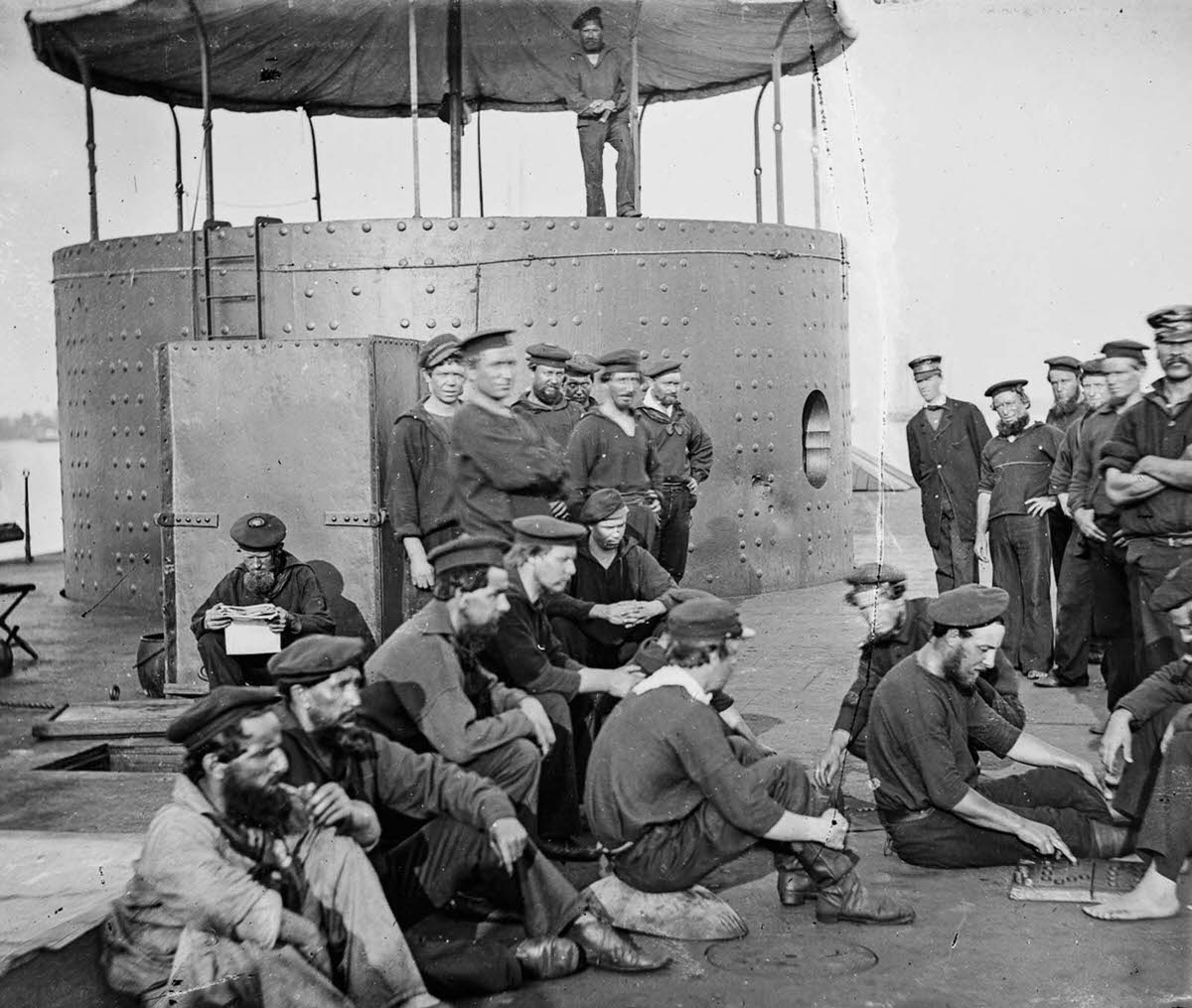
Riveted iron fills the frame, its curved turret wall rising like a factory boiler set afloat, while sailors gather in loose clusters across the flat deck. Some sit cross-legged or sprawl on rolled bedding, others stand shoulder to shoulder in dark work clothes and caps, their bearded faces turned toward the camera with a mix of fatigue and curiosity. A canvas awning stretches overhead, and one man keeps watch from above, emphasizing the cramped vertical world of a Monitor-class gunboat.
The details speak to the practical realities of naval service in 1864: hard metal underfoot, minimal railings, and a working surface meant more for machinery and maneuver than comfort. You can sense how a low-profile ironclad forced daily life into narrow spaces—men eating, waiting, mending, and passing time within arm’s reach of armor and gun ports. In a single scene, Civil War technology and ordinary routine meet on the deck of a warship built for close coastal and river fighting.
For readers exploring Civil War history, this photograph offers more than a look at an ironclad; it provides a rare, human-scale view of the crew who kept these armored vessels running. The turret’s porthole and the dense pattern of rivets underline the era’s industrial leap, while the sailors’ relaxed postures hint at the long stretches between action and the constant readiness that defined service afloat. Use this post as a doorway into Monitor-class design, naval life in the 1860s, and the lived experience behind the iron and steam.