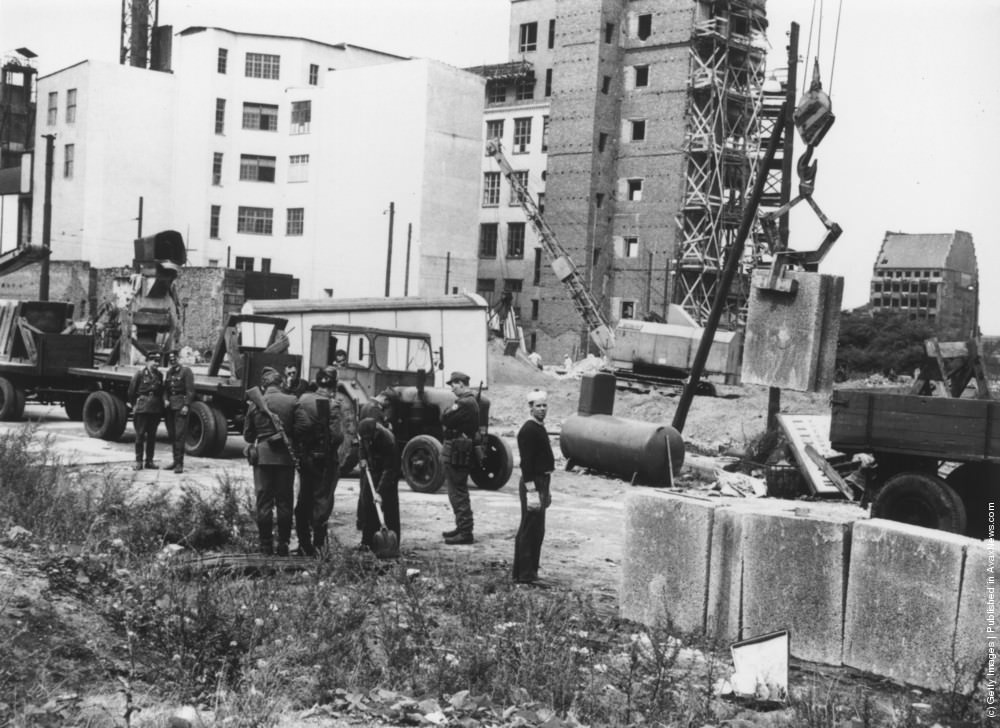
Steel, rubble, and raw concrete dominate the scene as uniformed East German military personnel cluster around heavy equipment, watching the work progress in a scarred urban corridor. A crane arm hangs over broken ground, trucks idle nearby, and the skeletal outlines of buildings and construction scaffolding rise in the background, turning an ordinary street edge into a controlled worksite. The title places this moment in August 1961, when the first barriers that would become the Berlin Wall were being pushed into place with startling speed.
Tension lingers in the body language: a small group stands in conversation while others face outward, as if scanning beyond the immediate task. The labor of division is visible in the material details—prefabricated blocks, a rough temporary surface, and the machinery needed to move and set massive components—suggesting how rapidly a political decision could be translated into physical reality. Here, supervision and construction blend into one operation, showing how security forces and infrastructure projects were intertwined at the Cold War’s most famous border.
Viewed today, the photograph reads as a documentary snapshot of the Berlin Wall’s early construction phase and the militarized atmosphere that accompanied it. For readers searching Berlin Wall history, East Germany 1961, or Cold War Germany, the image offers a grounded look at how boundaries were built not only with ideology but with trucks, cranes, and men in uniform. It’s a reminder that the wall began as a worksite—then became a world-shaping symbol of separation and control.