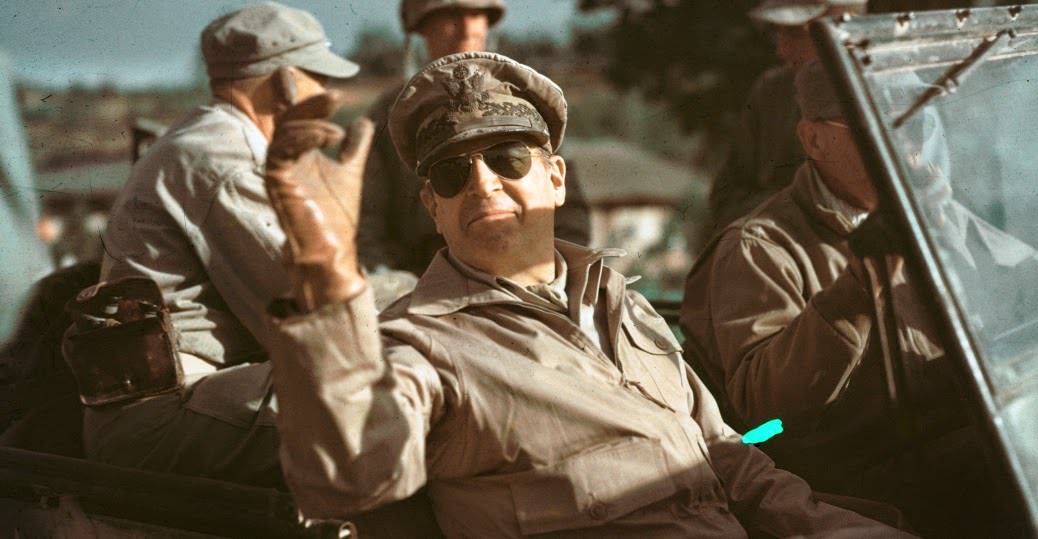
A uniformed general sits relaxed in an open vehicle, gloved hand raised mid-gesture, dark sunglasses catching the light as soldiers cluster around him. The crisp cap braid and tailored jacket insist on authority even in a casual moment, while the blurred figures in the background hint at a busy command environment. Details like the windshield frame and field gear suggest mobility and immediacy—the kind of scene shaped by an active front and constant briefings.
The title’s arc points straight to the Korean War and the unusual structure of a U.N. command led by a U.S. officer, a coalition effort burdened with enormous political stakes. In that context, the confident posture reads two ways at once: inspiring to supporters who wanted bold action, and troubling to officials wary of a commander who voiced disagreements publicly. Civil-military relations—how generals advise, how presidents decide, and how policy is communicated—hangs over the image like an unspoken argument.
April 1951 turned that argument into a national uproar when President Truman removed General Douglas MacArthur, unleashing a storm of controversy that rippled through Washington and across the wartime public. The photograph becomes more than a portrait of command; it serves as a visual doorway into debates over limited war, escalation, and the limits of military independence in a democracy. For readers searching Korean War history, Truman and MacArthur, or U.N. forces command, this moment captures the tension between battlefield certainty and political restraint.