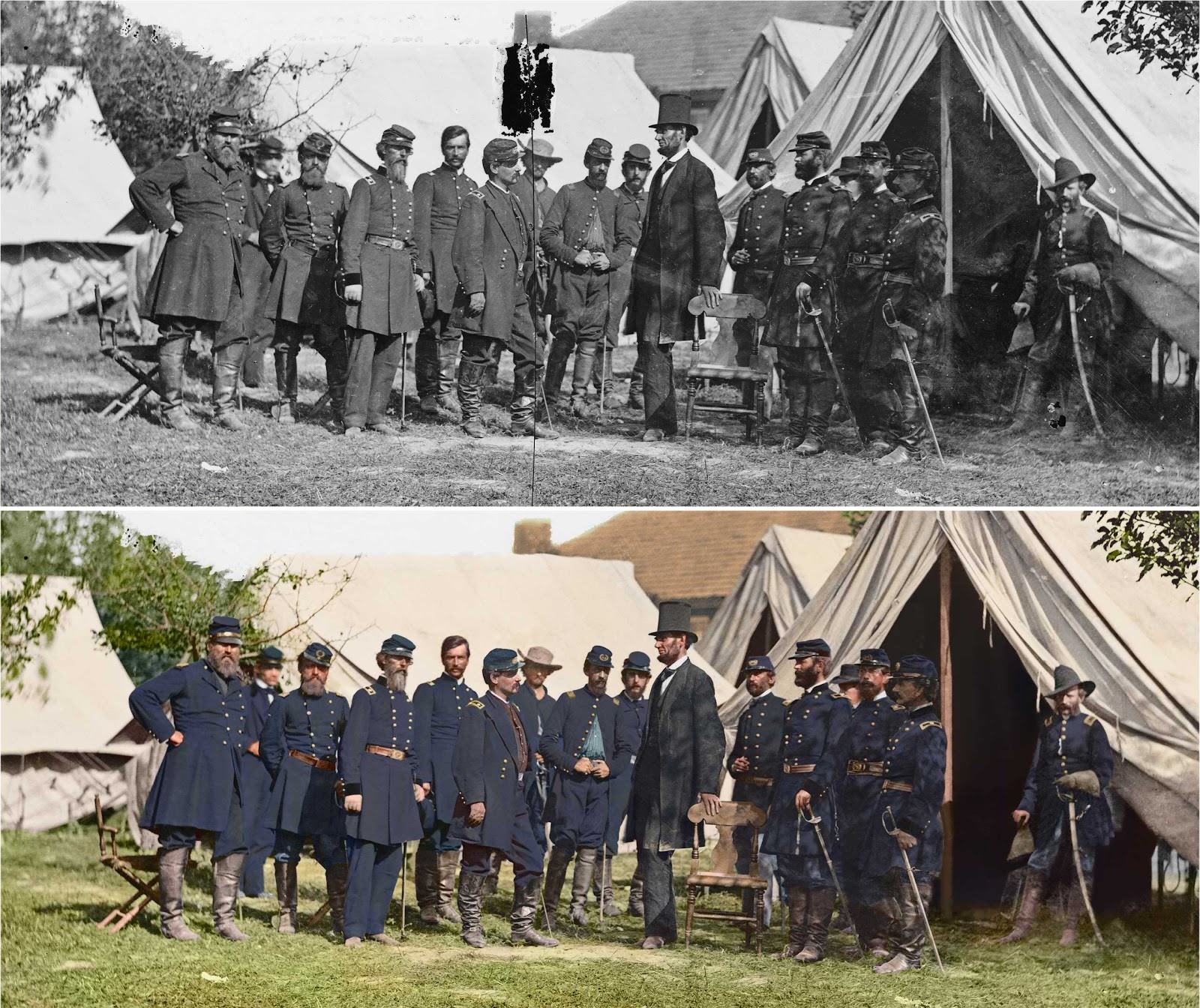
Amid canvas tents and trampled grass, President Abraham Lincoln stands in his tall hat among a ring of Union officers, his dark coat cutting a spare silhouette against the pale camp backdrop. The men around him wear the practical uniforms of the Civil War—caps pulled low, brass buttons catching the light, boots planted as if still braced for movement. A simple chair and scattered camp gear hint at the temporary, improvised world of a battlefield headquarters where decisions traveled faster than supplies.
Rather than posing in distant ceremony, Lincoln appears in the thick of military life, close enough to read faces and measure morale. The arrangement feels conversational: officers lean in, hands clasped or resting at their sides, while the President holds papers as though carrying the day’s reports. The tents form a rough corridor behind the group, suggesting a command post that could be struck and moved at a moment’s notice, a reminder of how fluid Civil War campaigns could be.
For readers searching Civil War history, Lincoln battlefield visits, or Union army camp scenes, this photograph offers a rare human scale to leadership in wartime. The colorized version draws out details that black-and-white can flatten—wool blues, weathered leather, and the sunlit folds of canvas—without changing the underlying tension of a nation at war. It’s an image of authority meeting uncertainty, where strategy, endurance, and the cost of conflict gather in a single frame.