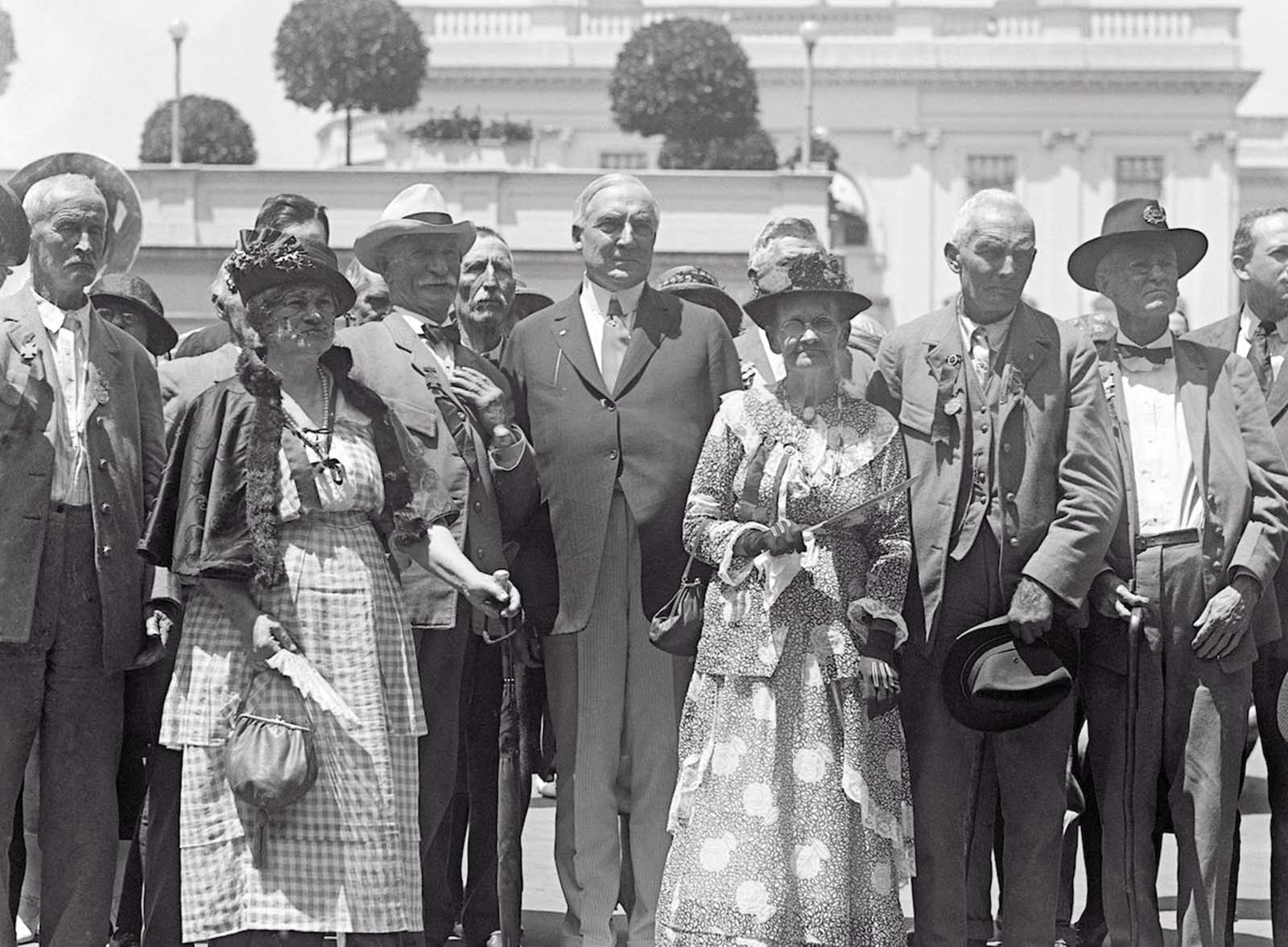
Sunlight hardens every line in this 1922 White House gathering, where President Warren G. Harding stands among veterans of the Confederate Army visiting Washington, D.C. after their annual reunion in Richmond, Virginia. The group reads like a cross-section of old age and memory: men with canes and watch chains, brimmed hats held at the waist, and women in formal dresses and broad hats that signal both ceremony and endurance. Behind them, the pale façade and clipped trees of the executive grounds anchor the moment in unmistakable national symbolism.
What draws the eye is the contrast between official power and personal history—Harding’s clean suit and upright posture set against faces weathered by time. Several attendees wear small badges and ribbons, modest markers of service that compress the vast Civil War into a few inches of metal and cloth. The veterans’ reunion culture of the early twentieth century depended on such rituals, transforming battlefield recollections into public pageantry, photographs, and handshakes that could be circulated as proof of recognition.
Yet the scene also hints at the complicated afterlife of the Stars and Bars in American civic life, especially when former Confederates are welcomed at the center of federal authority. By 1922, the war’s survivors were elderly, but the meanings attached to their cause were anything but settled, and public appearances like this helped shape how the nation narrated reunion, loyalty, and loss. For readers interested in Civil War memory, Confederate veteran reunions, and Washington, D.C. political imagery, this photograph offers a vivid snapshot of how the past was staged—and sanctioned—in the interwar years.