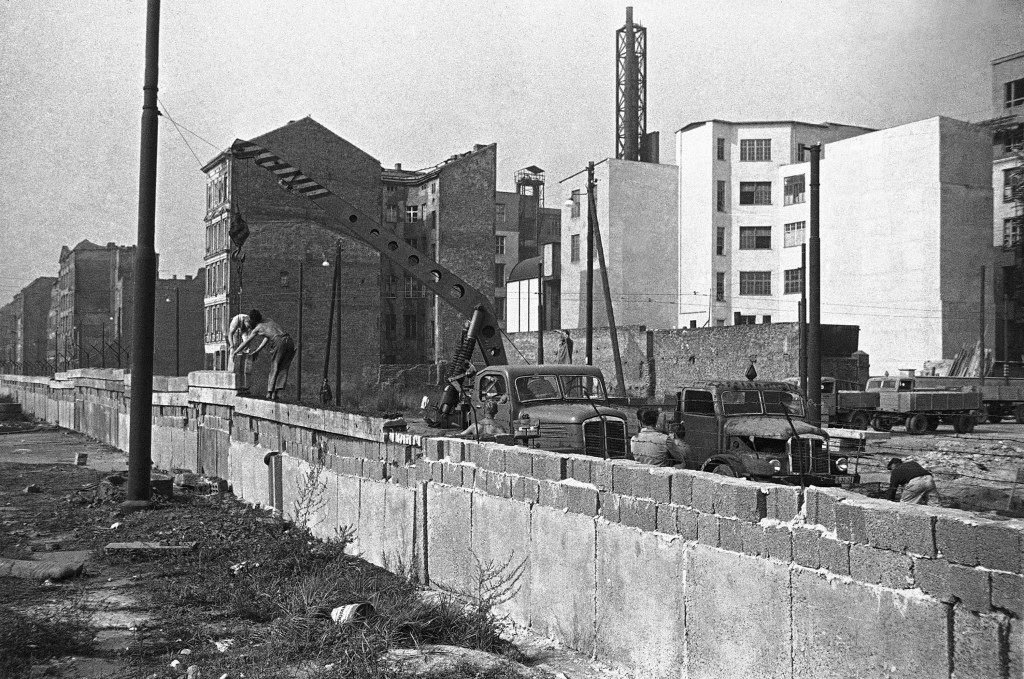
Concrete blocks run in a hard, uneven line through a scarred Berlin streetscape as a crane reaches over the barrier, turning construction into a public spectacle. Workers balance on the narrow top edge, guiding heavy sections into place while trucks idle nearby, their presence underscoring how quickly an improvised boundary was becoming fixed infrastructure. Behind the wall, bomb-damaged façades and newer apartment buildings stand side by side, a reminder that the city’s postwar rebuilding unfolded under mounting Cold War pressure.
Set along the border between East and West Berlin on Sept. 28, 1961, the scene reflects a decisive stage in the early construction of the Berlin Wall. The title’s mention of “concrete glass” points to the materials and tactics used to make crossing more difficult—adding height, weight, and hazardous surfaces to what had first appeared in many places as a rough, temporary divide. In the frame, everyday labor—ropes, steel, masonry, and muscle—becomes an instrument of state security, transforming streets into a controlled frontier.
For readers tracing Berlin Wall history, this photograph conveys the unsettling normality of a city being partitioned in real time. The wall is not yet the later, standardized barrier familiar from textbooks; it is a worksite, a line under constant adjustment, threaded through neighborhoods that still bear the marks of war. Seen today, the image invites reflection on how borders are built not only through politics and proclamations, but also through the quiet, relentless logistics of construction.