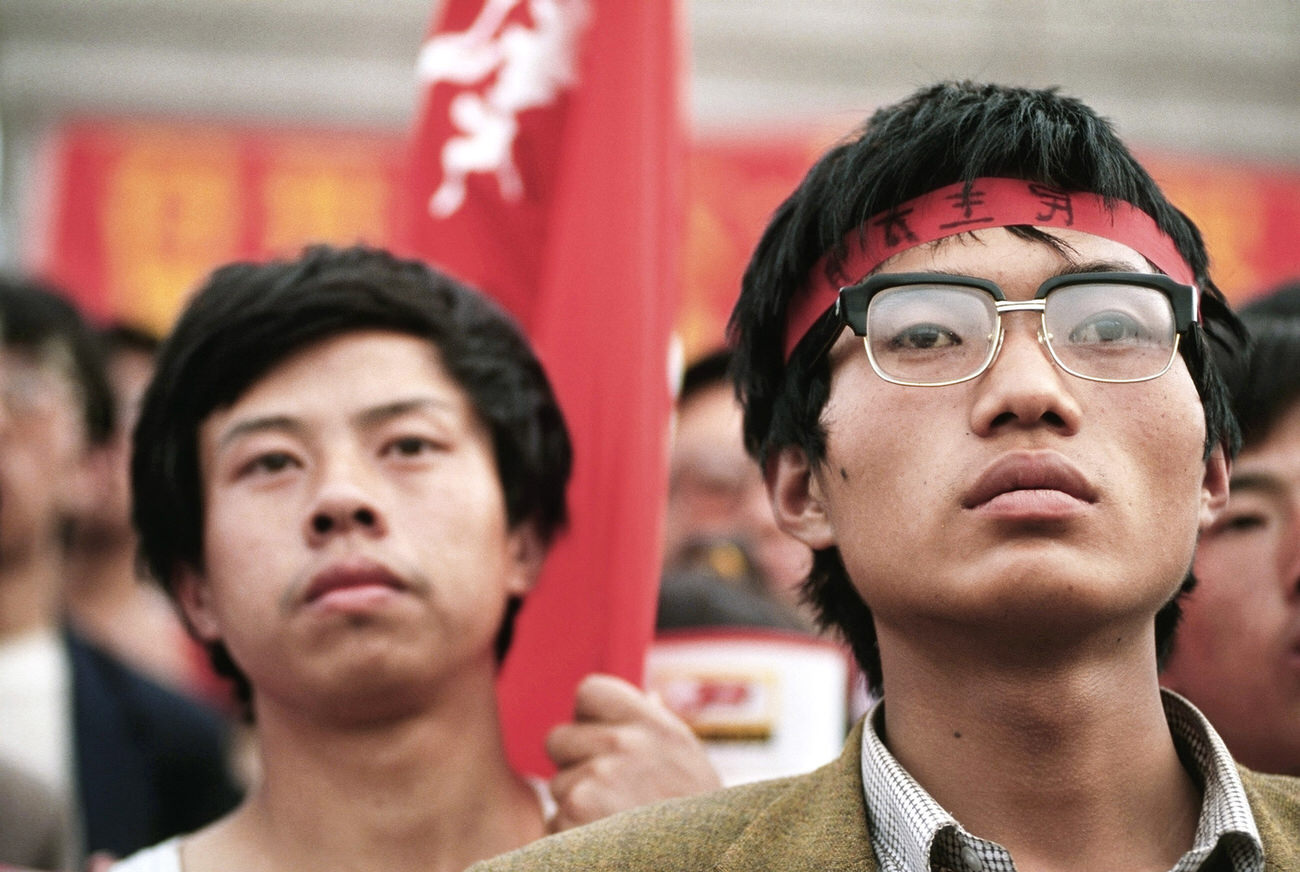
Dawn light seems to hang in the air over Tiananmen Square as protesters gather shoulder to shoulder, their faces fixed on a voice just out of frame. A young man in glasses stands in the foreground with a red headband marked by handwritten Chinese characters, his expression equal parts weary and resolute. Behind him, red banners rise above the crowd, softening into a blur that hints at numbers far larger than what the lens can hold.
What makes the scene so compelling is its intimacy: not a sweeping panorama, but a close view of attention itself. The grip on a banner pole, the set of a jaw, the steady forward gaze—small details that convey the discipline and hope of a pro-democracy movement in motion. Even without the speaker visible, the photograph records the moment when persuasion, solidarity, and fear coexist, and when listening becomes a political act.
For readers searching the history of Tiananmen Square protests and Chinese pro-democracy movements, this image offers a human-scale entry point into a famously contested chapter. It belongs to the visual language of civil conflict without battlefield smoke—where ideology is carried on cloth banners and written on headbands, and where the crowd’s quiet focus is the story. The photograph lingers as evidence of how quickly public squares can turn into stages for history, and how ordinary faces can become enduring symbols of civic courage.