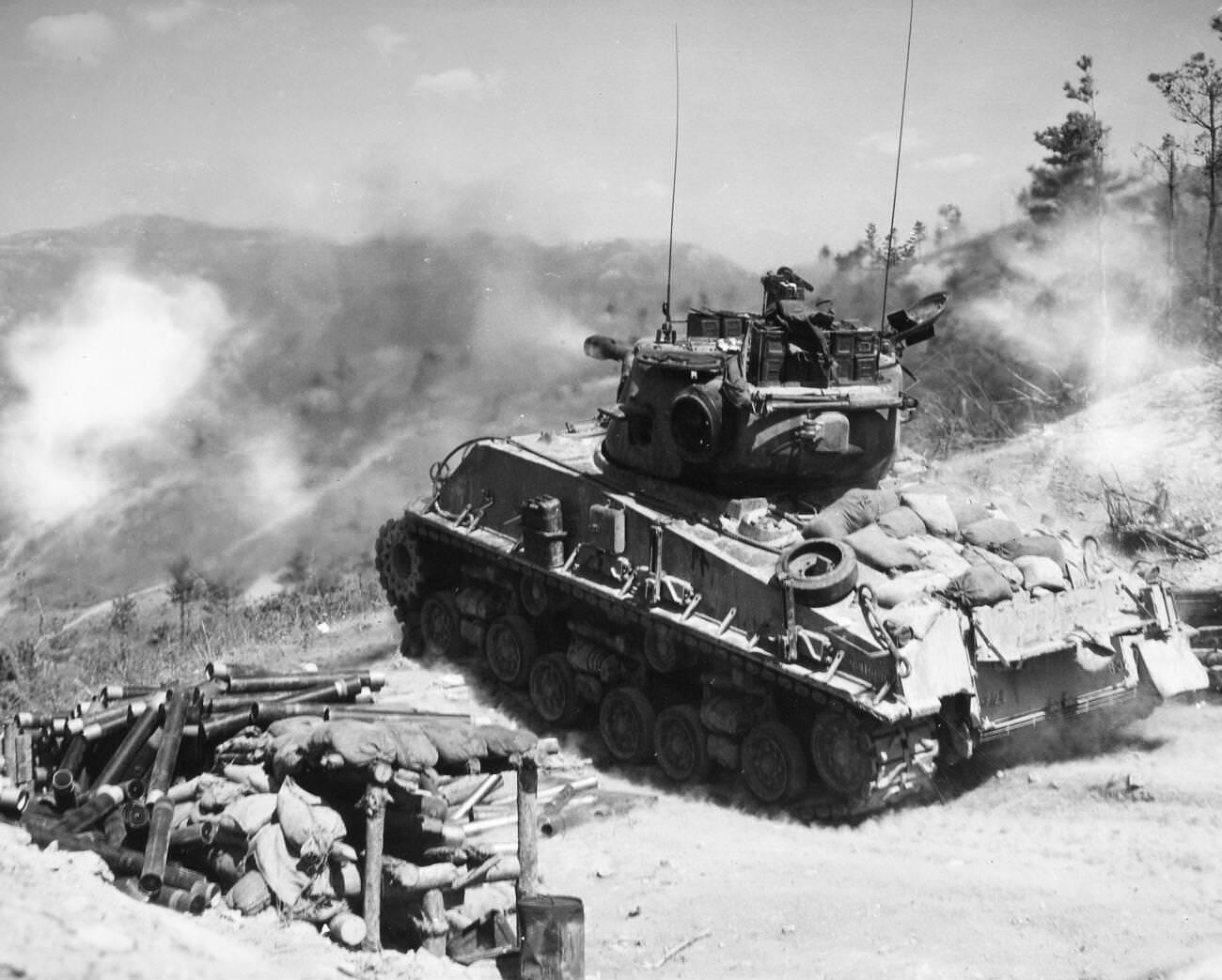
Perched on a rugged ridge, a U.S. Army tank of the 2nd Infantry Division sits behind a low wall of sandbags, its turret trained outward toward the Korean front. Smoke drifts across the hills as the gun fires, turning the surrounding air hazy and softening the distant mountain line. The scene compresses the Korean War’s harsh terrain into a single frame—rocky ground, sparse trees, and a fighting position carved into an exposed slope.
In the foreground, spent shell casings and ammunition containers spill across the earth, quiet evidence of sustained bombardment rather than a single dramatic moment. Antennas rise from the vehicle, and gear is strapped to the hull, hinting at the constant need for communication and improvisation in frontline conditions. The photo’s angle emphasizes both elevation and vulnerability: high ground offers commanding fields of fire, yet it also places men and machine in plain view of the enemy.
Set in 1952, the title’s reference to firing on Communist bunkers speaks to the entrenched, positional warfare that came to define much of the conflict after early maneuvers gave way to grinding stalemates. Armor like this served as mobile artillery, called upon to smash fortified points and support infantry in contested sectors where every ridge and valley could be turned into a defensive line. For readers searching Korean War history, 2nd Infantry Division operations, or battlefield photography from the era, this image delivers a stark, textured look at how the front was fought—one barrage at a time.