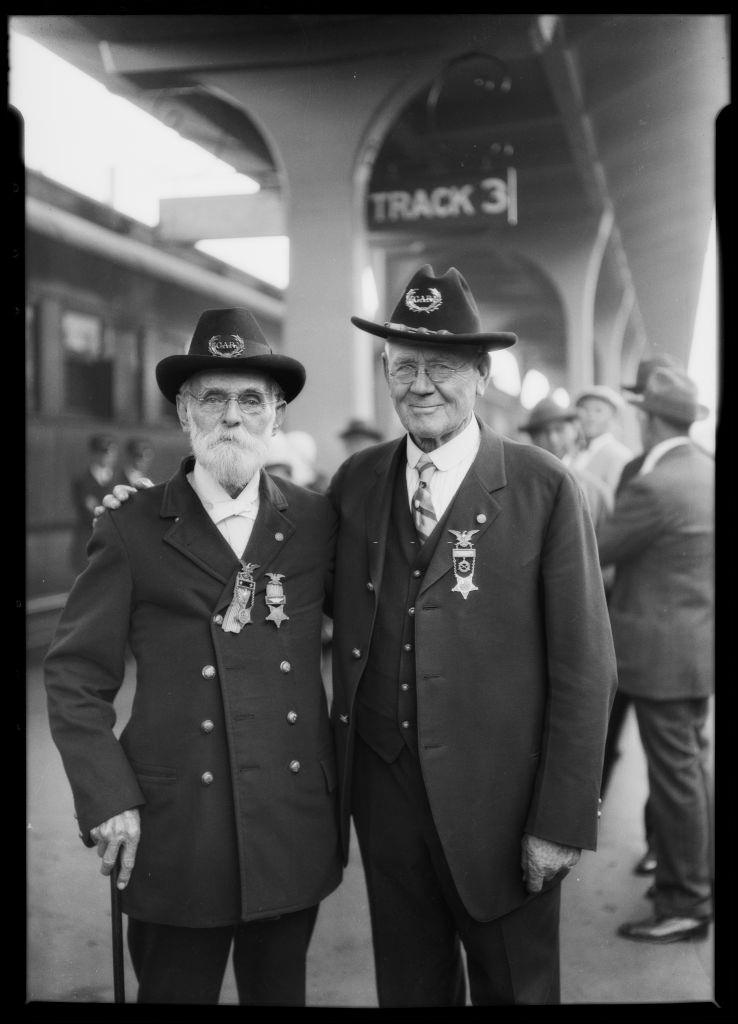
Under the high canopy of a Southern Pacific station platform, two elderly members of the Grand Army of the Republic stand close together, posed with the calm assurance of men long accustomed to being remembered. Their dark coats and brimmed hats carry the unmistakable GAR insignia, while medals pinned to their chests catch the light—small, heavy emblems of a war that had ended decades before this 1926 moment. One veteran rests a hand on a cane; the other’s arm settles companionably around his friend, turning a public place into a quiet scene of comradeship.
Behind them, the rhythms of rail travel frame the encounter: a passenger car sits along the platform and a bold “TRACK 3” sign hangs overhead, anchoring the setting in the everyday logistics of departure and arrival. The station architecture—thick columns, strong lines, and the soft blur of other travelers—suggests a bustling transit hub where modern America moved fast, even as Civil War survivors moved more slowly. The contrast is striking: age, medals, and memory in the foreground; motion and industry in the background.
For readers interested in the Grand Army of the Republic, Civil War veterans, and the culture of remembrance, this photograph offers more than a formal portrait—it’s a snapshot of how the conflict lingered in public life well into the twentieth century. By 1926, GAR gatherings, badges, and ceremonial attire helped keep wartime identities visible, especially in civic spaces like railroad stations where people met, traveled, and watched history pass by. Seen today, the image invites reflection on friendship after battle, the role of fraternal organizations, and the ways America carried its Civil War past into the age of trains and modern cities.