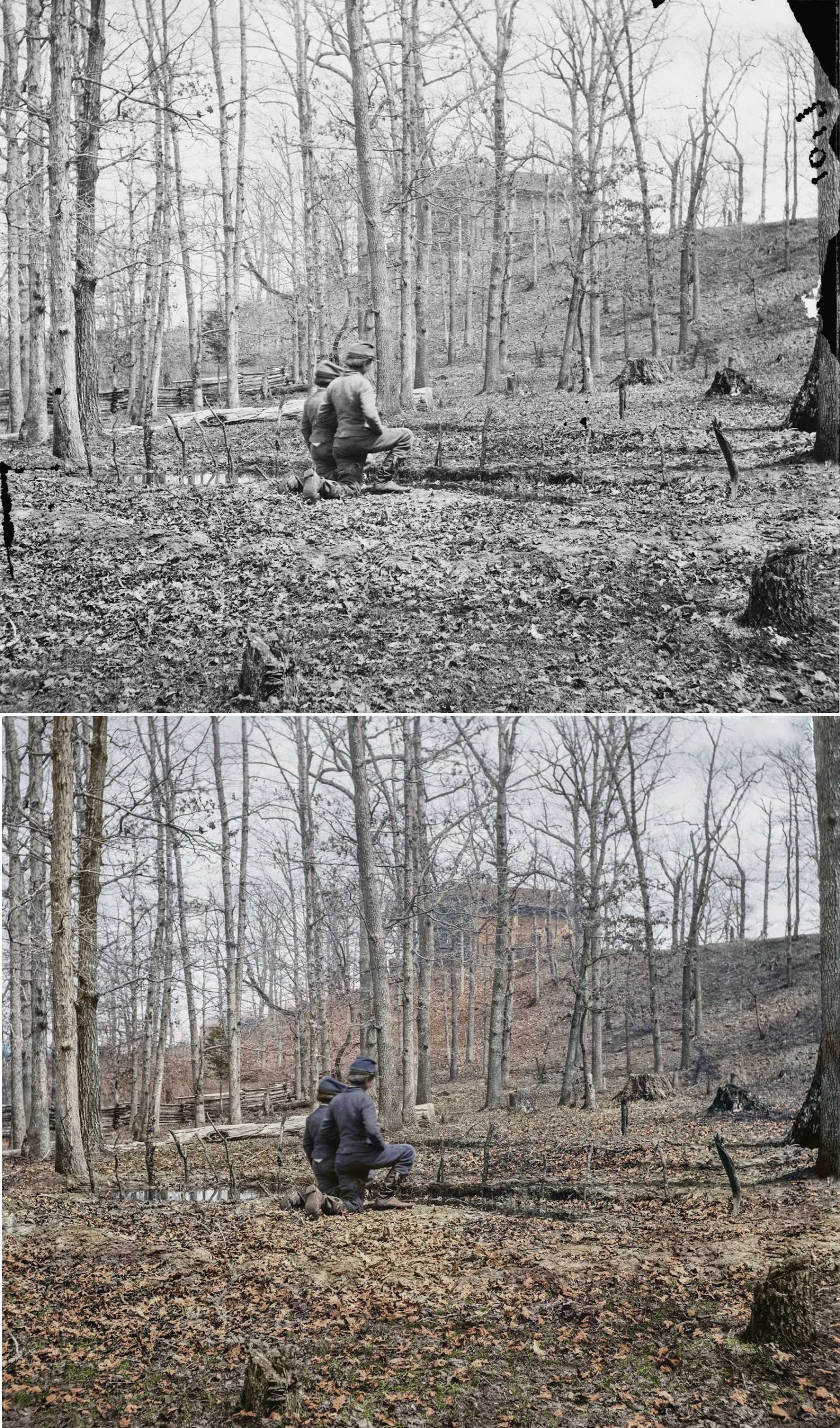
Quietly, two uniformed figures kneel on a leaf-strewn hillside, their bodies turned toward a small scatter of rough markers that break the ground in uneven lines. Bare trees stand like thin sentinels, and a split-rail fence recedes into the woods, emphasizing the rural character of the Sudley Church area near Bull Run, Virginia. The title’s date—March 1862—places this moment in the long aftermath of the early Civil War battles, when remembrance and recovery followed close behind the fighting.
In the distance, the church rises on higher ground, partly veiled by trunks and branches, giving the scene a solemn sense of separation between sanctuary and field. The composition draws the eye from the bowed heads in the foreground to the hillside beyond, suggesting how quickly a battlefield could become a graveyard. Even without visible faces, the posture of the kneeling soldiers reads as an act of mourning, prayer, or quiet respect for the dead.
Such photographs matter because they document more than military movements; they preserve the emotional landscape of the American Civil War and the ways ordinary people confronted loss. Sudley Church near Bull Run remains a powerful keyword for historians and readers tracing the war’s impact on Virginia communities and soldiers in the field. Here, remembrance is not ceremonial grandeur but a spare, human gesture—two men, a handful of graves, and a cold season’s woods holding their silence.