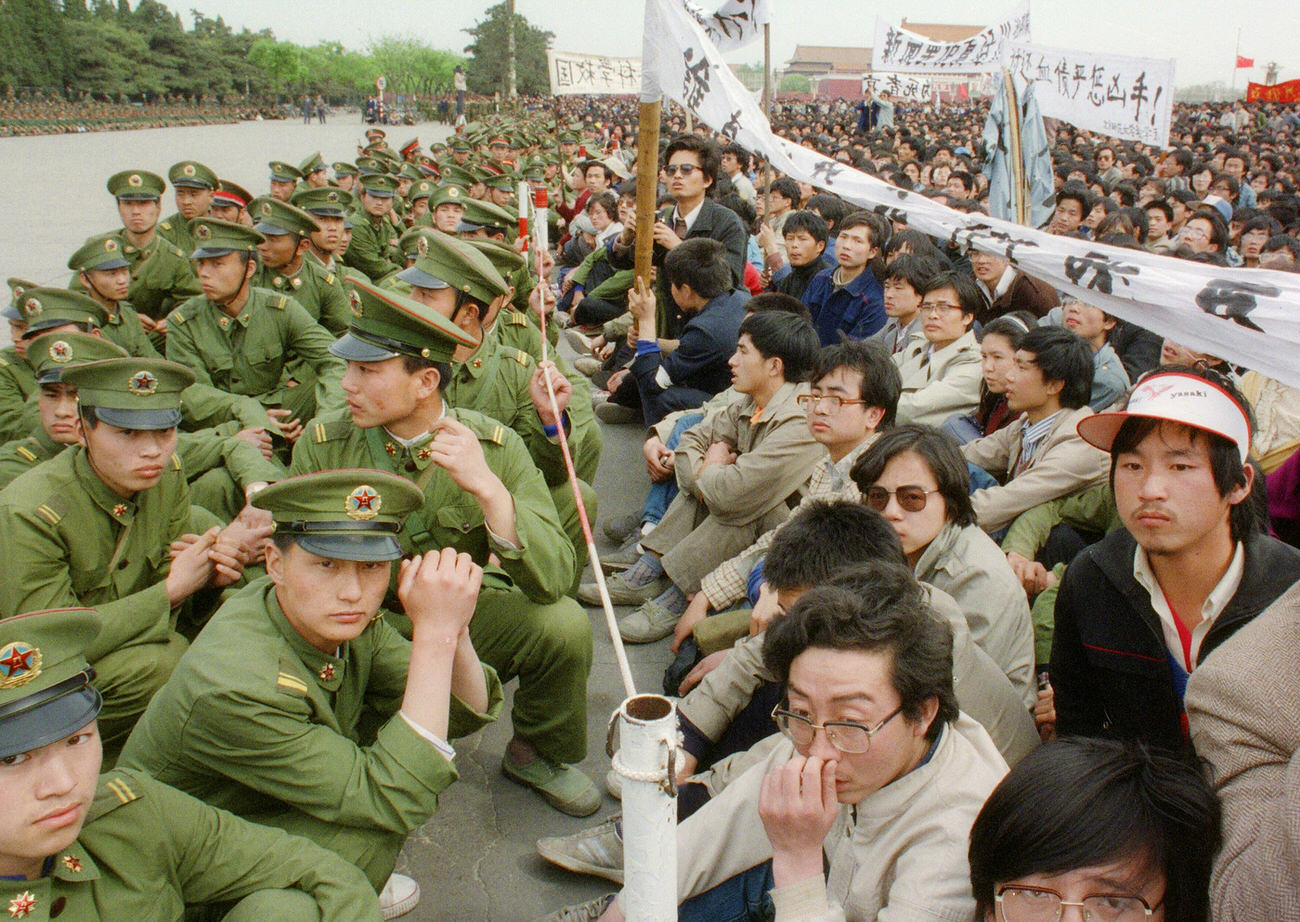
Two lines of young faces meet across the asphalt outside the Great Hall of the People: student protesters seated shoulder-to-shoulder on one side, uniformed police officers crouched and packed tightly on the other. The composition turns a public boulevard into a narrow corridor of tension, where caps, badges, and pressed green jackets contrast with casual coats, glasses, and the weary posture of those holding their ground. In the distance, the crowd thickens into a living wall, suggesting that this encounter is only the front edge of a much larger movement.
Banners with bold Chinese characters rise above the seated ranks, and strips of white cloth ripple like improvised standards in a wind that seems to carry both hope and uncertainty. The protest’s disciplined stillness reads as strategy as much as sentiment—an insistence on being seen and heard without yielding the street. Meanwhile, the police line mirrors that discipline, eyes scanning, hands resting on knees, their proximity making the standoff feel intimate rather than abstract.
Seen today, the photograph offers a vivid, searchable window into pro-democracy student protests, civil unrest, and state power in late-20th-century China, anchored by the unmistakable landmark named in the title. It reminds viewers that history is often decided not only by speeches and decrees, but by hours of sitting, waiting, and refusing to move. For readers exploring civil wars and their surrounding struggles—political legitimacy, public space, and the cost of dissent—this scene distills the precarious moment when a crowd and a government measure each other at arm’s length.