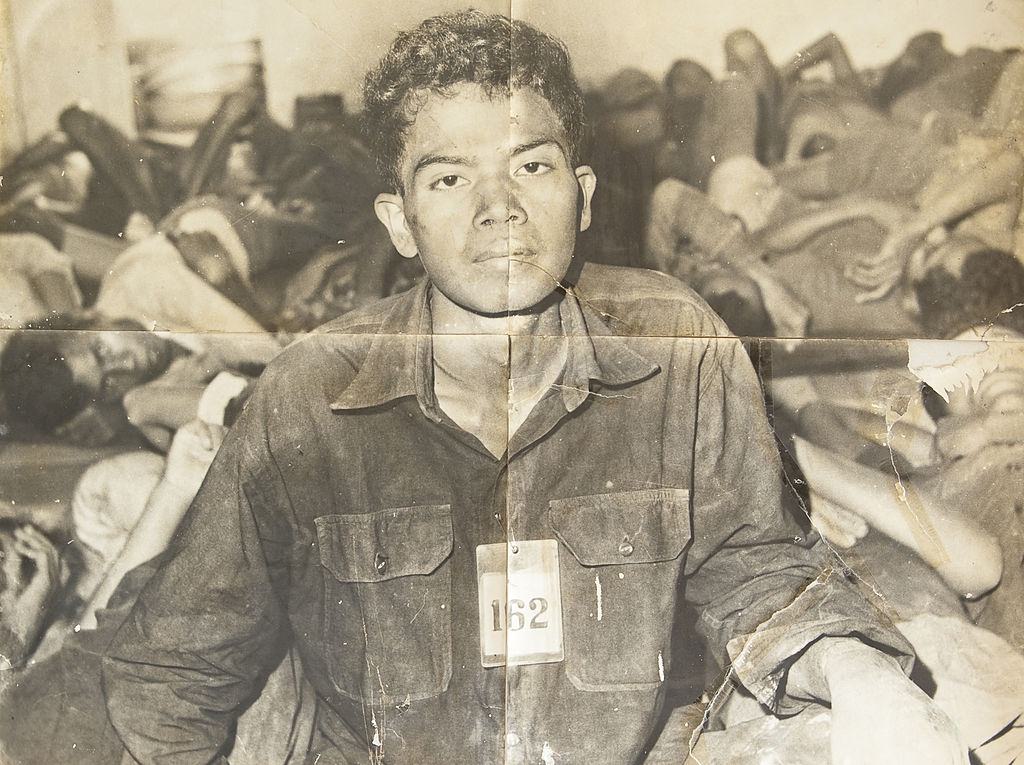
A young man sits close to the camera with a numbered tag pinned to his shirt, his face steady and exhausted as he looks straight ahead. Behind him, the frame dissolves into a crowded blur of bodies and limbs, suggesting a space where people were packed together and reduced to indistinct shapes. The creases, scratches, and torn edges of the print add another layer of violence—evidence not only of what was recorded, but of how fragile these records have been over time.
In the context of S21 in Phnom Penh, Cambodia, such portraits carry a chilling administrative purpose: identification, cataloging, and control. The plain clothing, rigid posture, and stark lighting speak to an environment built to strip away individuality while still preserving a single, unavoidable proof that someone was there. As a document of civil wars and state terror, the photograph confronts viewers with the uneasy intersection of bureaucracy and human suffering.
Memory work begins with small details, and here the number on the chest becomes a grim substitute for a name that the image does not provide. For readers searching the history of S21, Tuol Sleng, the Khmer Rouge period, and the victims documented in Phnom Penh, this post reflects on what it means to see one person clearly while a multitude remains indistinguishable in the background. It is a reminder that historical photos are not merely illustrations—they are remnants of lives caught in systems designed to erase them.