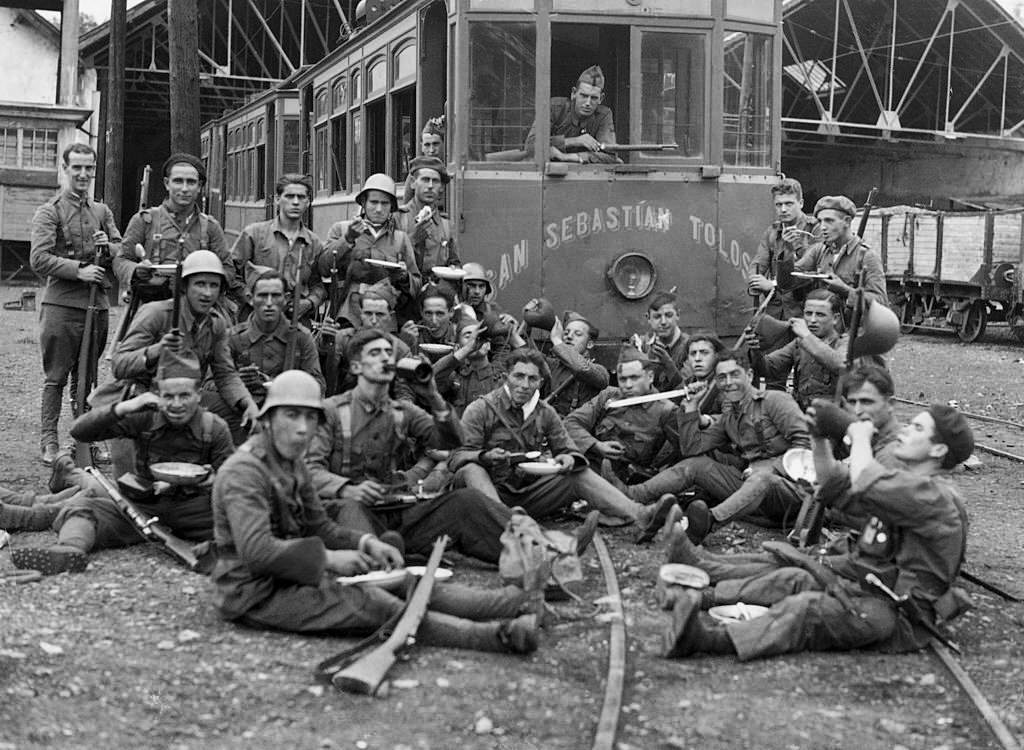
Crowded around a railcar marked with the route to San Sebastián and Tolosa, a group of uniformed men pause on the tracks in a moment that feels both casual and charged. Some sit or sprawl on the gravel, eating from tins, while others keep their rifles close at hand; the mix of relaxed postures and ready weapons captures the uneasy rhythm of a civil war. Behind them, the ironwork and glass of the station structure frame the scene like a cavernous stage, emphasizing how quickly civilian spaces could become military assets.
San Sebastián in 1936 stood at the crossroads of movement and control, and the train station was far more than a backdrop. Rail lines meant supplies, reinforcements, and information—lifelines that could decide whether a city held or fell. The presence of Nationalist troops occupying this hub suggests an effort to secure logistics and signal authority, turning platforms and carriages into checkpoints and billets as the conflict spread across Spain.
What makes the photograph linger is its human texture: young faces, varied helmets and caps, and the improvised intimacy of men gathered in a place built for departures. The station’s rolling stock and visible route lettering anchor the image to real geography, while the scattered kit and stacked bodies tell a wider story of militarization in everyday life. For readers searching the Spanish Civil War through primary images, this scene offers a stark, SEO-friendly glimpse into how occupation looked on the ground—part routine, part tension, and entirely shaped by the struggle for transit and territory.