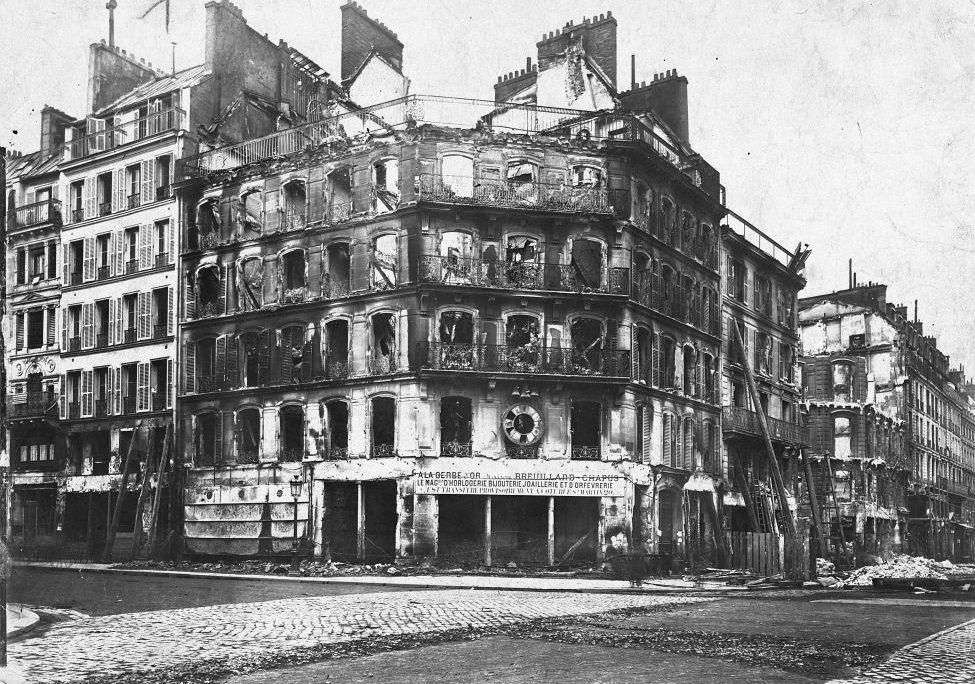
Soot-darkened masonry and empty window bays turn this Paris corner building into a blunt witness to the aftermath of the Franco-Prussian War and the surrender of France. The curved façade, once designed to draw the eye along a busy intersection, now reads like a ledger of violence—floors stripped to their frames, shutters hanging askew, and the roofline broken where fire bit deepest.
Along the ground level, traces of everyday commerce stubbornly remain: painted signage stretches across the storefronts, and a round clock still clings to the frontage as if time might resume on schedule. Yet the street feels hollow, its broad cobbles leading past rubble and scarred walls, while neighboring buildings show their own bruises in cracked plaster, torn openings, and exposed interior voids.
Seen as a historical photo of Paris under occupation, the scene speaks to more than architectural damage; it evokes the social shock of defeat, requisition, and reprisal that can follow a civil war atmosphere even when armies have stopped moving. For readers searching the Franco-Prussian War’s urban impact, occupation-era destruction, or the visible marks left on Parisian streetscapes, this image offers an unvarnished study in how conflict reshapes a city—one burned corner at a time.