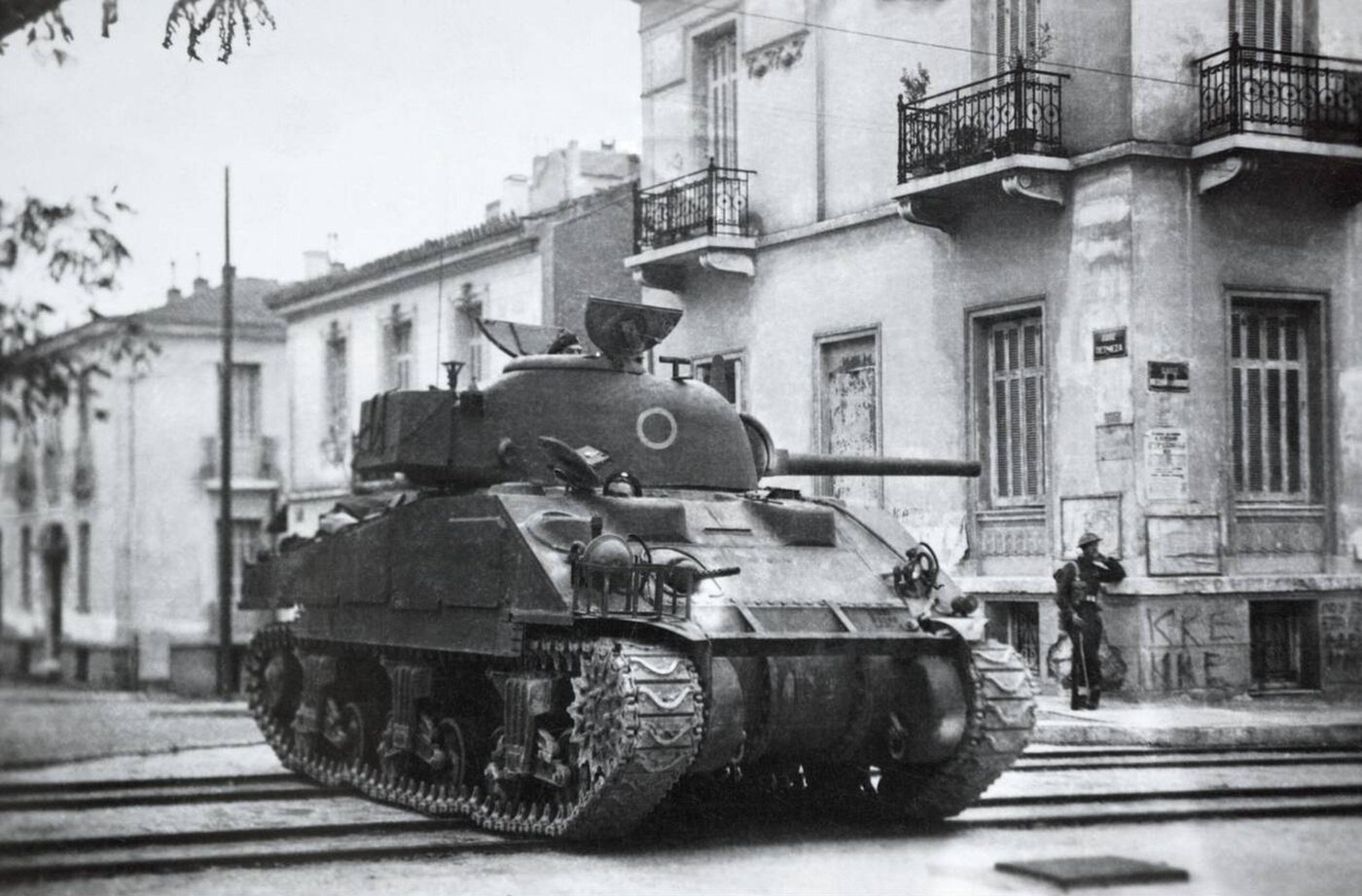
Armour fills the narrow frame on Petmeza Street in Athens, where a Sherman tank from C Squadron, 46th Royal Tank Regiment sits heavy on the road, its turret angled down the line of buildings. The balconies and shuttered windows of the surrounding houses feel close enough to touch, turning an ordinary city block into a corridor of tension. Tracks and steel dominate the foreground, a reminder that in December 1944 the battle for control was being fought not on distant fronts but in lived-in neighbourhoods.
To the right, a soldier of the 23rd Armoured Brigade stands beside political graffiti associated with the KKE, and the contrast is striking: a human figure next to hurried lettering, both dwarfed by the tank’s bulk. The wall becomes a contested surface, carrying messages that outlast the momentary pause of a patrol. Even without hearing a shot, the photograph conveys the uneasy stillness of street fighting—watchfulness, improvised signs, and the sense that every corner might matter.
Dekemvriana is often discussed through high politics and shifting alliances, yet images like this bring the conflict down to street level, where ideology, propaganda, and firepower meet in plain view. For readers searching the history of the Greek Civil War’s opening violence, British armoured units in Athens, or the presence of Sherman tanks in urban operations, this scene offers vivid context. It preserves a fragment of a city caught between liberation and division, when graffiti and armour spoke in different languages but to the same uncertain future.