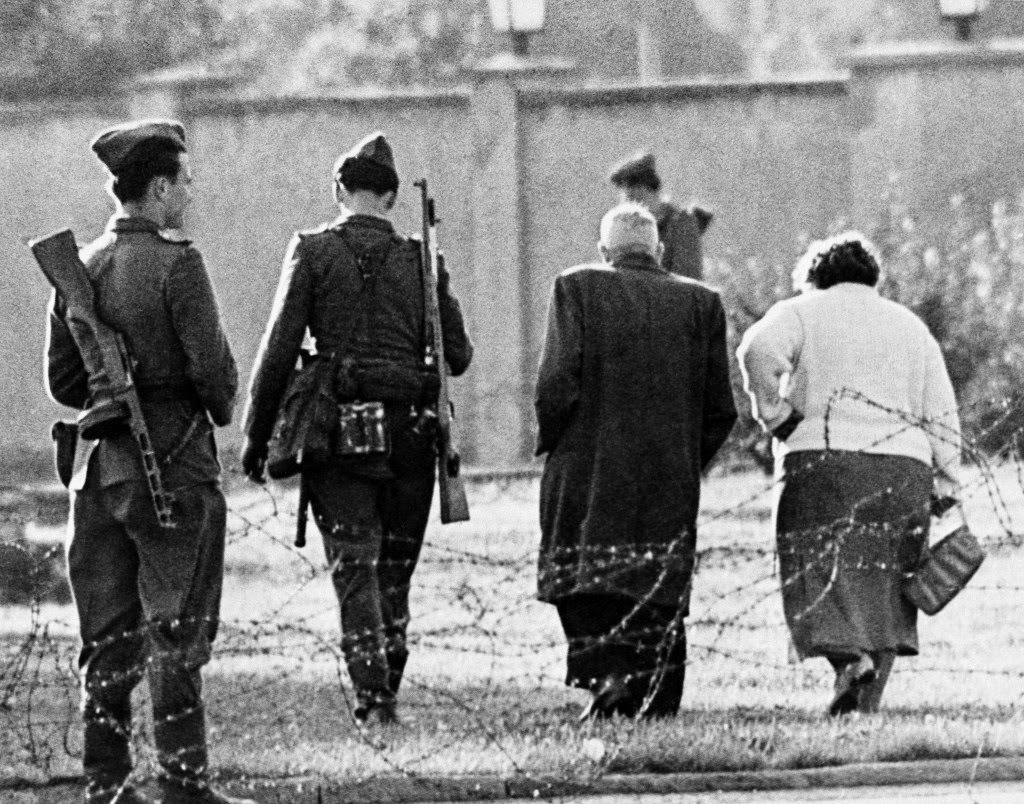
Barbed wire cuts across the foreground like a jagged signature, marking the sudden hardening of a border that had once been porous. Two East German soldiers, rifles slung and posture controlled, stand close enough to make their authority felt, while an older man in a dark coat and a woman with a handbag are guided away from the crossing. The scene is sparse—wire, uniforms, and a few figures—yet it speaks loudly about the first hours of the Berlin Wall’s creation on Aug. 13, 1961.
Behind the couple, the landscape feels unfinished and provisional, as if the barrier has been thrown up in a hurry and will be “temporary” only in name. A third uniformed figure blurs in the distance, reinforcing the sense that surveillance is already layered and systematic. The couple’s turned backs matter here: the drama isn’t a clash in motion, but the quiet moment of refusal, when a personal decision meets the machinery of the state.
Viewed today, this historical photo anchors the Cold War in human scale, turning geopolitics into a story of ordinary people caught between East Berlin and West Berlin. The coils of wire and the disciplined spacing of the soldiers foreshadow the concrete, checkpoints, and controlled passage that would soon define the Berlin border. For readers searching for Berlin Wall history, East German border guards, and the realities of 1961, this image remains a stark reminder that borders are built not just with materials, but with enforced outcomes.