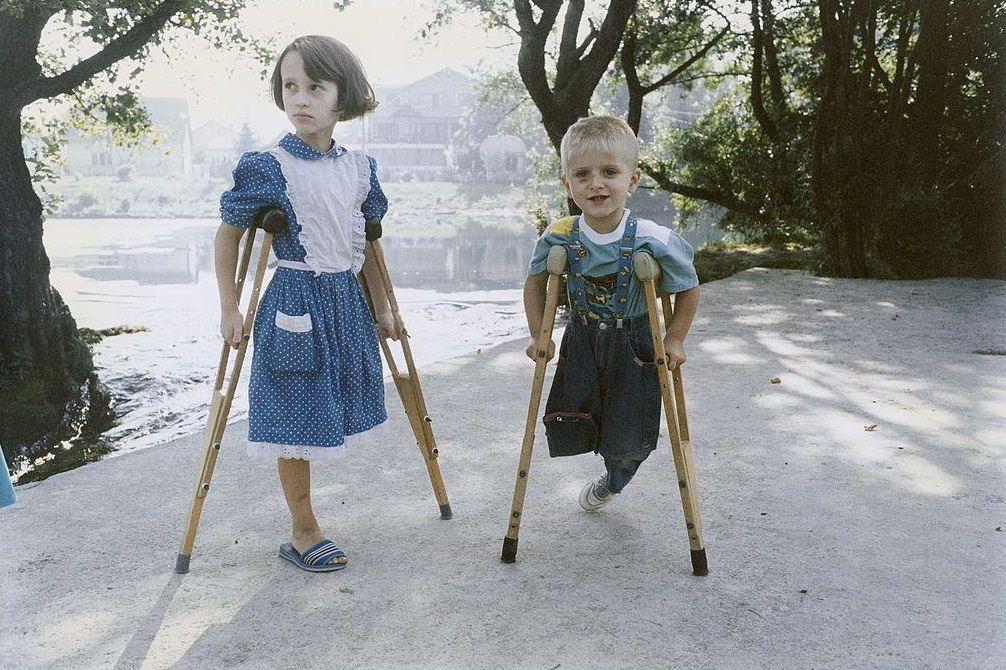
Under the shade of broad trees beside a calm stretch of water, two very young children move forward on wooden crutches along a sunlit path. The girl’s blue dress and the boy’s small overalls suggest ordinary childhood, yet their posture and the careful placement of each step reveal the extraordinary burden carried in their bodies. Behind them, hazy buildings and still reflections create a quiet backdrop that makes their presence feel even more stark.
The title names them—Sanja, 7, Serbian Orthodox, and Aladdin, 4, Muslim—and places their injuries within the siege of the Bihać enclave, a chapter of civil war violence that left civilians trapped and children especially vulnerable. Here, religious identity appears not as doctrine but as a reminder that war’s harm crosses community lines, striking the smallest lives in parallel ways. The crutches become a brutal shorthand for what the siege stole: safety, mobility, and the assumption that childhood will be protected.
Seen today, the photograph works as both documentation and warning, a humane entry point into the history of the Bihać siege and the wider Balkan conflicts that produced so many displaced and wounded civilians. It invites readers to look beyond headlines and consider the long aftermath—rehabilitation, prosthetics, family care, and the psychological weight of surviving. For anyone searching for historical images of child victims of war, this scene offers an unforgettable, sobering record of innocence reshaped by civil conflict.