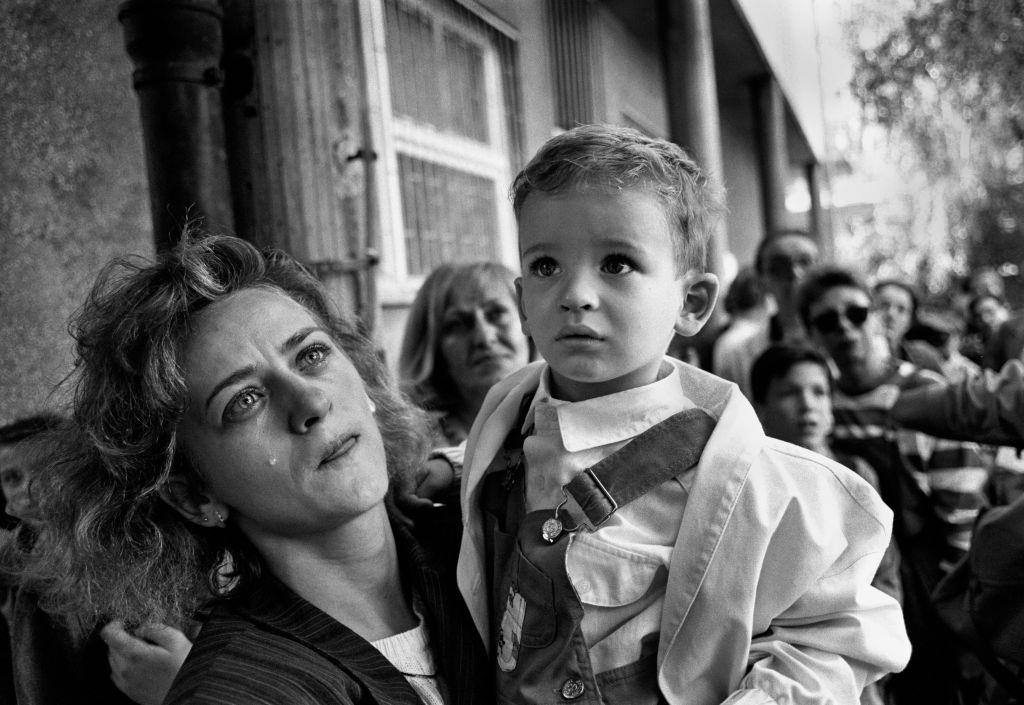
Tears cling to a mother’s face as she holds her small boy close, her gaze lifted as if searching for certainty where none can be found. The child, bundled in a light jacket over buttoned clothing, stares ahead with a wide, uncertain expression that feels painfully out of place among the tense adults behind them. Set against the hard lines of a building and a crowded queue, the moment reads as both intimate and public—private grief unfolding in the open during the siege of Sarajevo in 1992.
Behind the pair, other faces form a blurred chorus of worry, hinting at the mass decisions families were forced to make when survival depended on departure. The title’s mention of a bus “promised safe passage” by Serb forces adds a chilling layer: safety offered as a condition, not a certainty, and trust reduced to a gamble. In the photo’s tight framing, the mother’s grip and the boy’s confusion become the story of displacement itself—love acting as the last barrier before separation.
For readers searching the history of the Bosnian War, the Sarajevo siege, and civilian evacuations, this image anchors big events in a single, unforgettable exchange between parent and child. It is a document of civil war not through weapons or ruins, but through expression: the wet track of a tear, the protective tilt of a shoulder, the stunned calm of a child who cannot understand why goodbye has arrived. Long after the headlines fade, scenes like this explain what conflict steals first—ordinary life, and the assumption that a mother can keep her child safe simply by holding on.