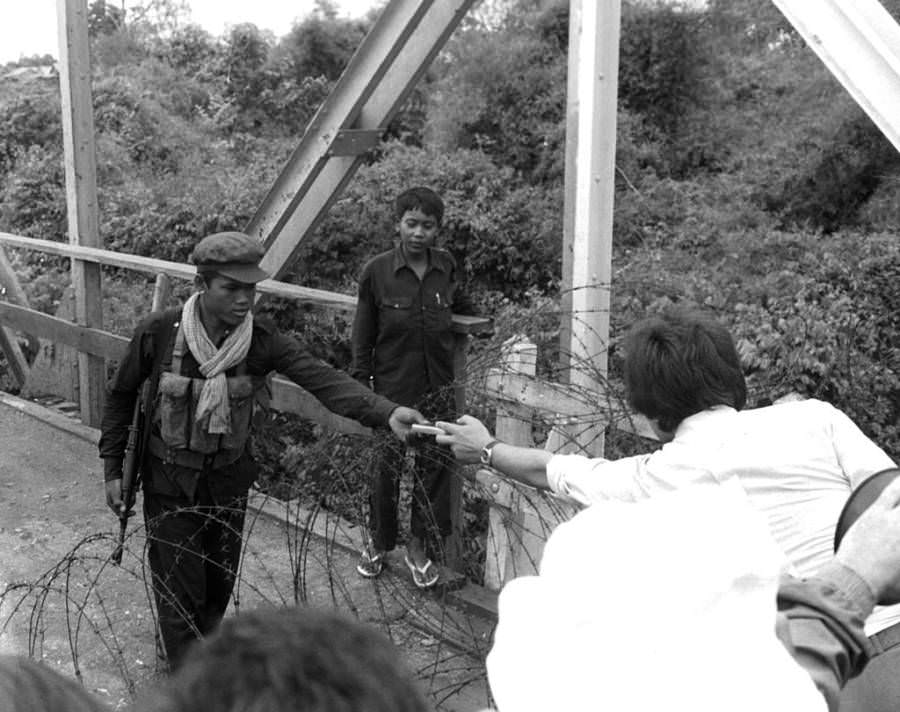
On a tense stretch of roadway in Phnom Penh in 1975, a small gesture crosses a hard line: an employee at the French Embassy extends a cigarette toward a Khmer Rouge soldier. The soldier stands with his rifle at the ready, a scarf looped at his neck and a cap pulled low, while barbed wire and the steel frame of a bridge or checkpoint structure cut across the scene. Behind him, another figure watches quietly, turning the exchange into a tableau of caution, curiosity, and wary proximity.
The power of the photograph lies in its contradictions—civility offered in the middle of civil war, diplomacy reduced to the reach of a hand, and everyday habits persisting beside instruments of control. Even without hearing a word spoken, the body language suggests negotiation: the embassy staffer leans forward from a safer side, the soldier steps in just enough to accept, and the barriers remain firmly in place. It’s a moment that hints at how quickly Phnom Penh’s rhythms were being rewritten, from streets and offices to checkpoints and guarded crossings.
As a historical record, the image speaks to the broader story of Cambodia’s upheaval, when foreign missions, residents, and local people navigated uncertainty under rapidly changing authority. Details—barbed wire, uniforms, the tight framing around hands and weapon—anchor the viewer in the lived texture of 1975 rather than in abstract headlines. For readers searching the history of the Khmer Rouge, Phnom Penh, and the human side of civil wars, this photograph offers a stark reminder that epochal shifts can be seen in the smallest exchanges.