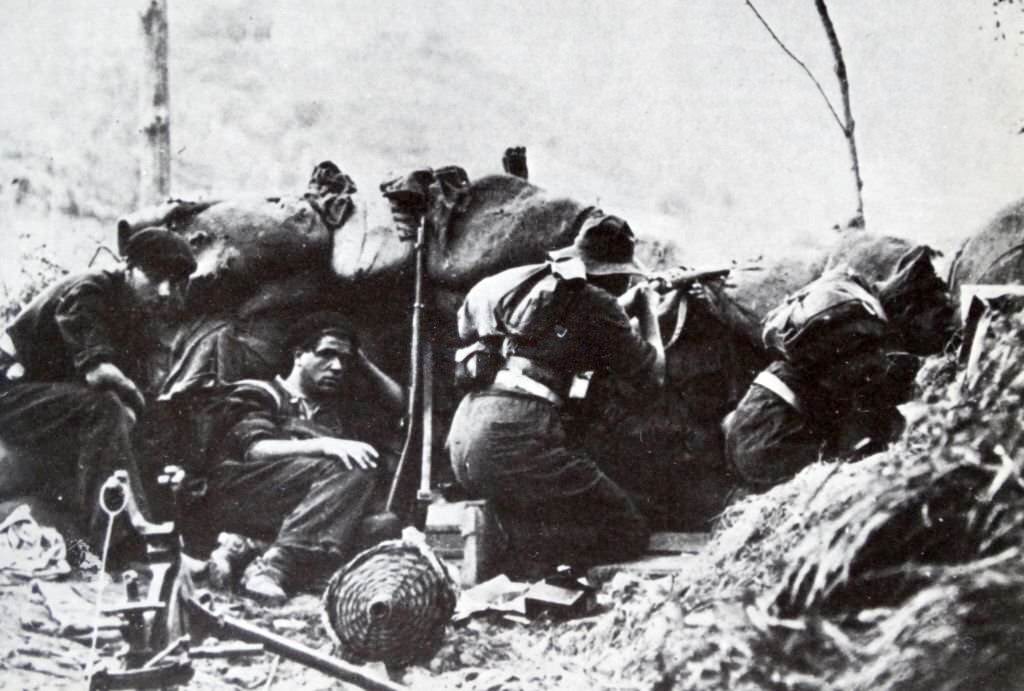
Pressed into the earth behind a low wall of sandbags, Republican soldiers wait out the violence of the Campaign of Gipuzkoa during the Spanish Civil War. One man lies slumped with exhaustion, while another braces himself to fire over the parapet; the trench is cluttered with the practical tools of survival—coiled wire, a canteen, and scattered supplies—suggesting a position meant to be held, not merely passed through. The composition emphasizes the cramped, improvised nature of frontline defenses, where a few feet of dug-in ground could mean the difference between shelter and exposure.
The tension in the scene comes from contrasts: stillness and motion, fatigue and alertness, bodies at rest and bodies poised to shoot. Uniforms and gear appear worn and functional, blending into the mud and rough timber, and the background dissolves into a bright haze that feels like smoke, dust, or overexposed daylight—anything that turns distance into uncertainty. Even without visible opponents, the posture of the men and the tightness of the space convey the constant pressure of artillery and small-arms fire that defined trench fighting in northern Spain.
Set against the title’s reminder that the Nationalist Army ultimately conquered Gipuzkoa, the photograph reads as a fragment of a broader military collapse and human ordeal. It offers a grounded view of how the Spanish Civil War was fought at the soldier’s level: dugouts, sandbags, limited cover, and long stretches of waiting punctuated by sudden danger. For readers exploring the Campaign of Gipuzkoa, Republican defenses, and the northern front, this image provides an intimate, SEO-friendly window into the realities of combat and the cost of contested territory.