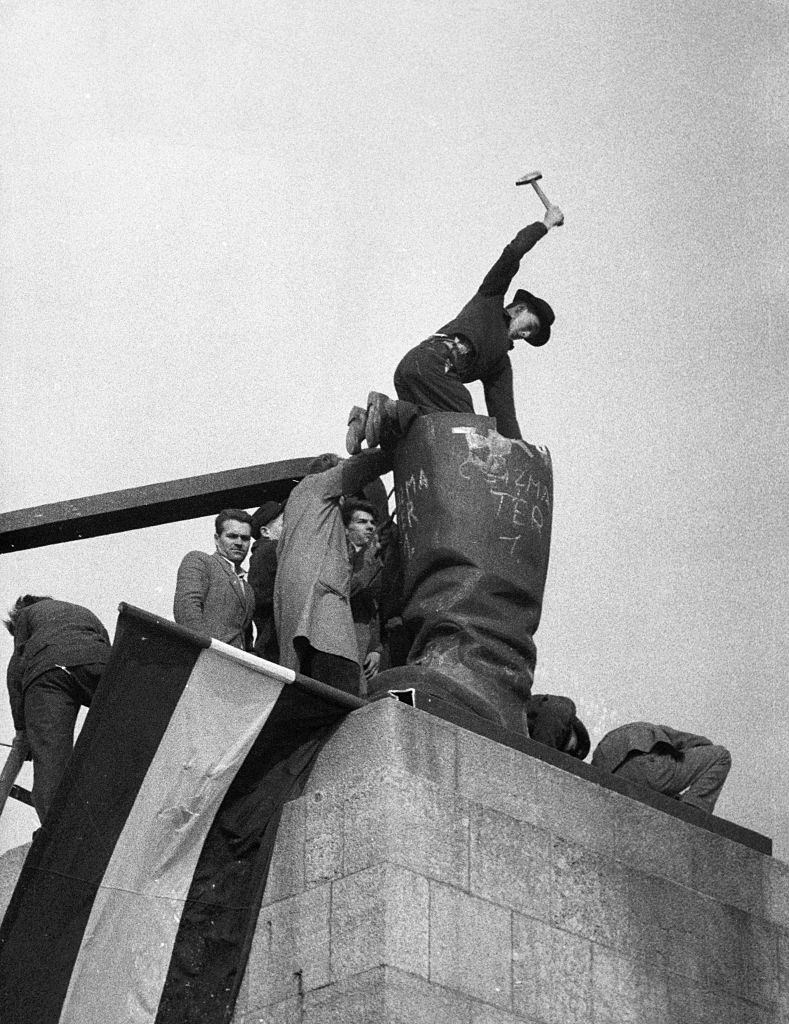
High above the crowd, a man braces himself on the pedestal and swings a hammer down into the massive remains of a Stalin statue, turning an icon of authority into cracked stone and fragments. Around him, others cling to the monument’s base and scaffolding, watching, steadying, and helping in a tense choreography that feels both improvised and determined. The open sky and stark angles of the plinth emphasize the scale of the task: dismantling not just a sculpture, but a public symbol meant to loom over daily life.
Revolutions often make their arguments in plazas as much as in pamphlets, and few acts broadcast a new political reality more loudly than the toppling of a dictator’s image. Here, the damage is already visible—scored surfaces, missing sections, and hurried markings—suggesting a moment when fear has shifted sides and the crowd can finally approach what once seemed untouchable. In the context of civil wars and upheaval, such scenes capture the volatile intersection of street power, propaganda, and the struggle to control public memory.
For readers exploring Cold War history, anti-Stalin protests, or the broader story of de-communization, this photograph offers a vivid entry point into how regimes rise and fall in the built environment. Statues are designed to last, yet they can be undone quickly when legitimacy collapses, and the physical labor of breaking stone becomes a kind of collective verdict. The image lingers as a reminder that the fight over monuments is never only about art—it is about who gets to stand for the nation, and who is finally dragged down from the pedestal.