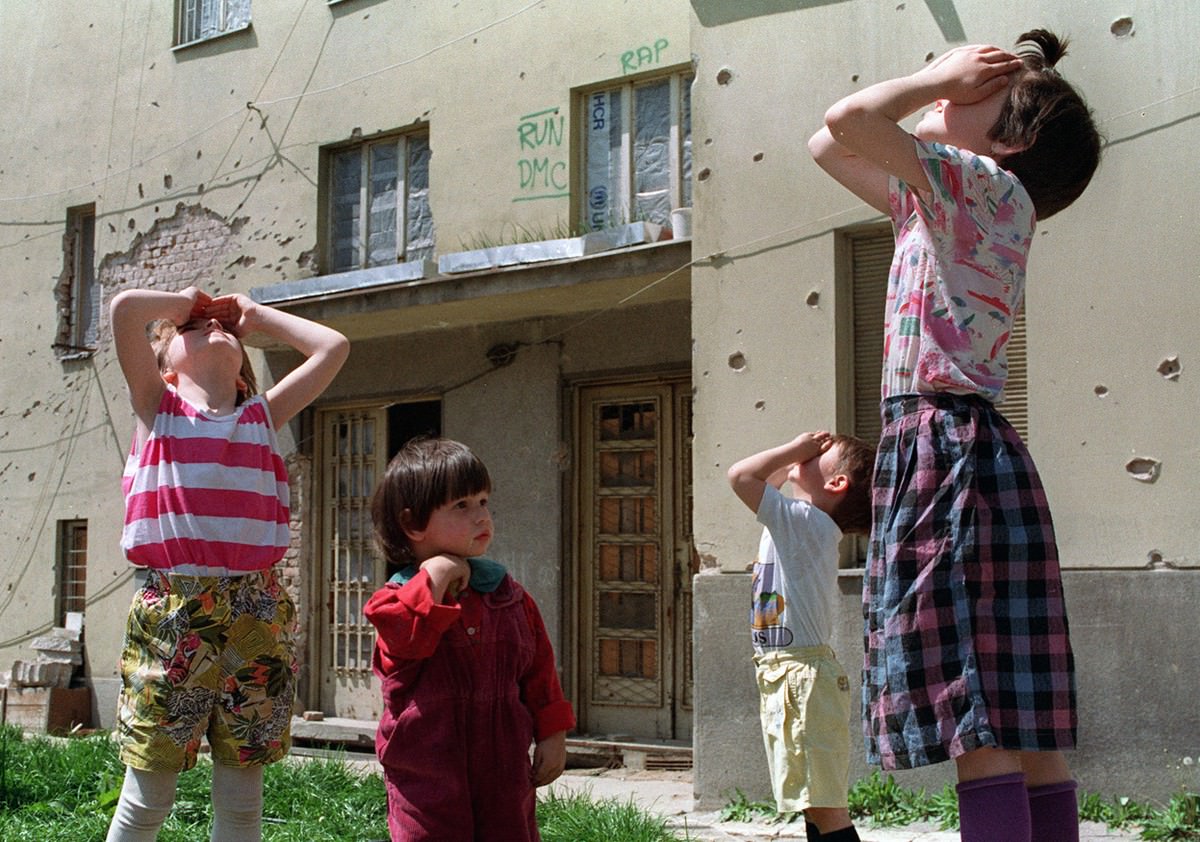
Under a pockmarked facade in Sarajevo, a small group of children tilt their faces toward the sky, hands shielding their eyes as they search for the fighter jets enforcing the no-fly zone on May 12, 1993. The chipped plaster, exposed brick, and spidering cracks on the apartment wall speak of nearby violence, while the kids’ bright shirts and shorts insist on ordinary life pressing forward. Even the scribbled graffiti and taped windows become part of the scene’s uneasy normalcy, a civilian streetscape shaped by siege conditions.
In the foreground, one child watches the others rather than the heavens, caught between curiosity and caution, as if listening for sound before committing to wonder. The stance of each figure—heads thrown back, elbows raised—turns the moment into a kind of shared ritual, a community reacting to a presence that cannot be controlled but can be witnessed. Here, air power is not an abstract policy term; it’s a daily sensation above damaged homes, threading fear, relief, and uncertainty into a single glance upward.
Placed within the wider context of the Bosnian War and its civil-war ruptures, the photograph distills how international intervention intersected with the rhythms of childhood. “No-fly zone” sounds procedural, yet the image underlines its human setting: residential courtyards, scarred walls, and young lives learning the language of aircraft and survival at the same time. For readers searching Sarajevo 1993, Bosnia Herzegovina war photography, or accounts of civilians under siege, this frame offers a stark, intimate entry point into that history.