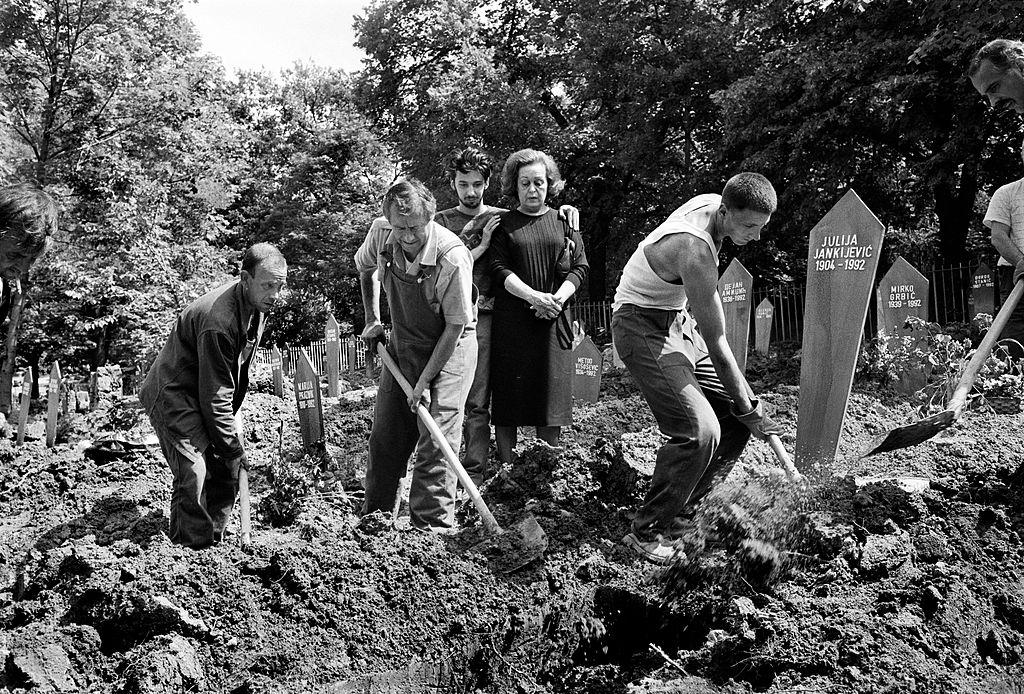
Under a canopy of summer leaves, gravediggers work the churned earth of Lion Cemetery in Sarajevo in 1992, their shovels cutting into a slope already crowded with fresh mounds. Upright headstones punctuate the background in uneven rows, while the men in the foreground bend into the labor with the practiced, heavy rhythm of necessity. The scene’s calm natural setting clashes with the urgent pace suggested by the disturbed ground, a quiet hillside turned into a place of constant arrivals.
Nearby, mourners stand close together, faces drawn and posture rigid, watching as soil is lifted and thrown. One figure appears to steady another, a small gesture of support amid the blunt mechanics of burial. The cemetery’s markers—some clearly inscribed, many partly obscured—remind the viewer that each mound corresponds to a life, and that civil war measures its passage not only in headlines but in graves.
As a historical photo from the Bosnian war era, this moment offers an unembellished look at how communities endure siege and violence: through work, witness, and ritual carried out in public view. For readers searching for Sarajevo 1992 history, Lion Cemetery, or wartime burial practices, the image anchors abstract conflict in physical details—mud on boots, spade blades, the angle of a headstone. It is a stark document of civil wars’ most intimate consequence, recorded in a place meant for remembrance.