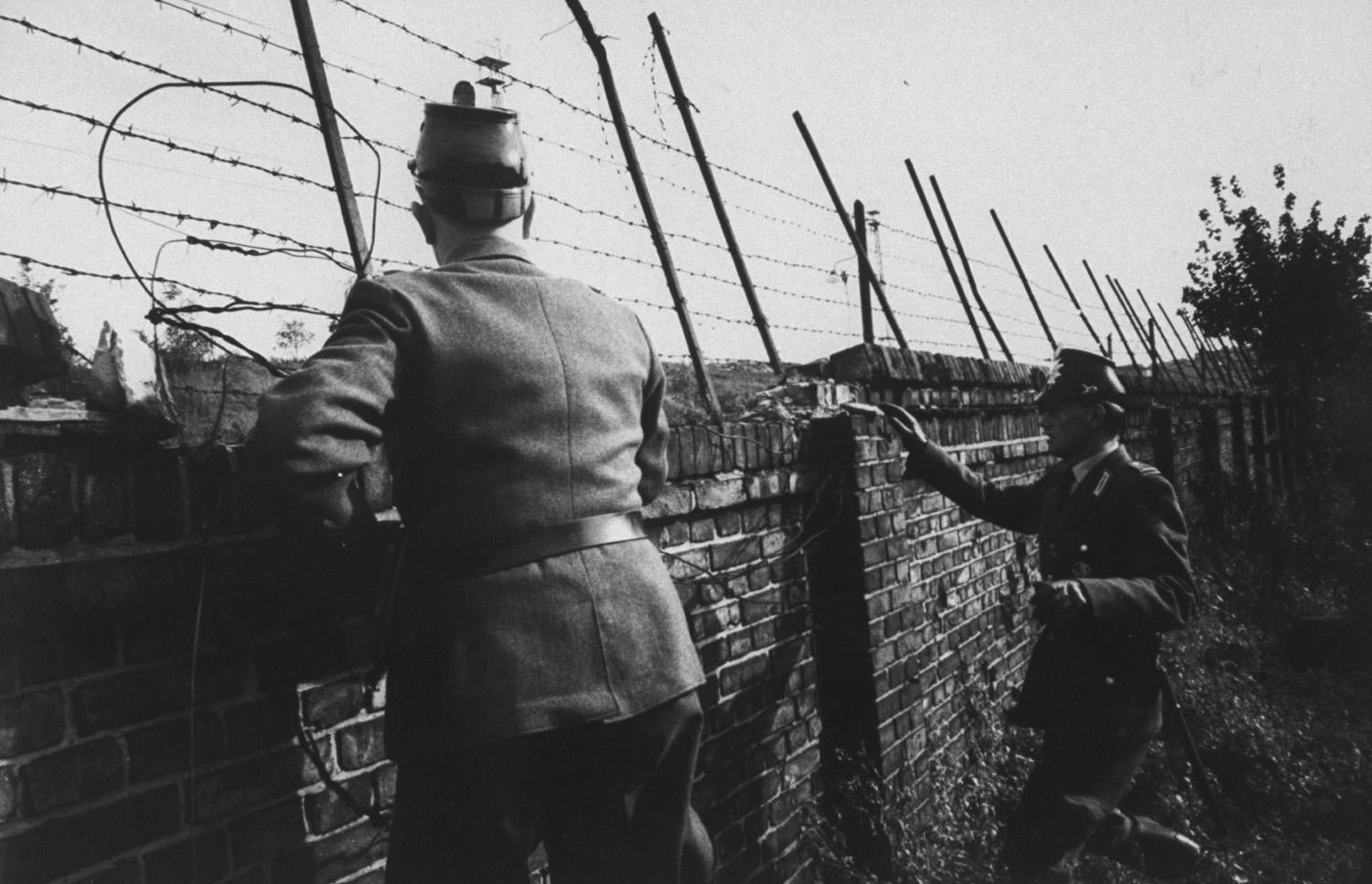
Barbed wire slants overhead like a warning written in metal, while two West German police officers lean toward the barrier to scan what lies on the other side. The rough brickwork and improvised fencing speak to the Berlin Wall’s early days, when the border was still being hardened and every gap felt like it might close for good. In this stark October 1961 moment, their posture—half watchful, half ready—suggests a frontline where the distance between hope and danger was measured in meters.
Along the wall, the angled posts and tangled coils create a visual corridor that pulls the eye into the background, emphasizing just how quickly an urban boundary became a fortified divide. One officer braces himself against the top of the bricks, as if trying to see beyond the obstacles without exposing too much of his own body. The scene is quiet on the surface, yet it carries the tension of Cold War Berlin, when movement across the border could trigger alarm, pursuit, or worse.
October 1961 was a time when the Wall was not only a structure but a crisis unfolding in real time, with desperate decisions made under the gaze of uniforms on both sides. The title’s note that police looked out to offer help to potential escapees hints at the human stakes behind the geopolitics—people weighing a sudden sprint, a climb, or a hidden route against the risks of capture. For readers searching for Berlin Wall history, early border fortifications, and Cold War-era photographs, this image captures the uneasy blend of surveillance, solidarity, and uncertainty that defined the divided city.