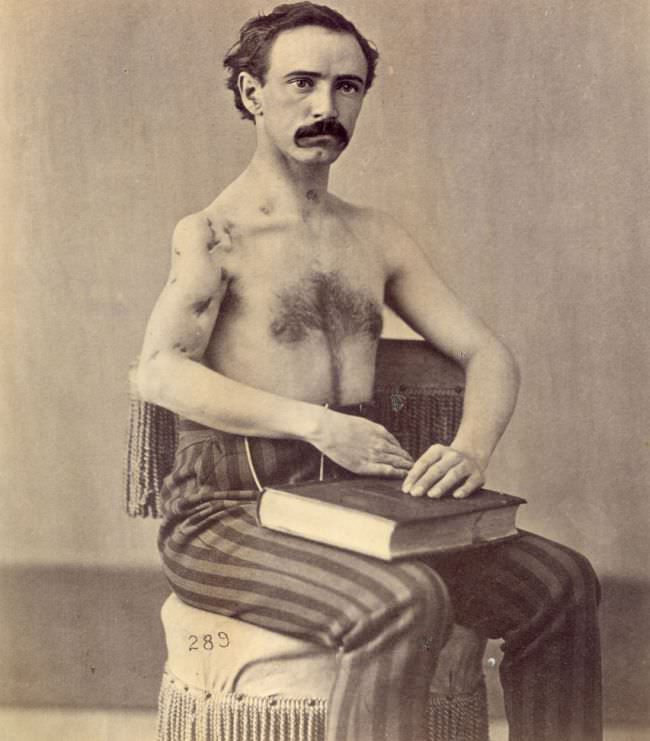
Quietly posed on a studio chair, Private James P. faces the camera with an unflinching steadiness that makes the medical reality of war impossible to ignore. His bare torso and careful posture draw the eye to the injured arm, while the stark backdrop leaves nothing to distract from the human cost behind the uniform. A thick book rests in his lap, adding a striking contrast between the calm, orderly setting and the violence implied by the title.
The caption’s account—his humerus fractured by a gunshot and later removed—points to the hard choices of Civil War medicine, when surgeons often resorted to excision to save a life. Marks and uneven contours along the upper arm suggest trauma and healing, recorded not as a private wound but as evidence. Photographs like this were frequently made to document injuries and outcomes, serving both as a record for military hospitals and as a grim lesson in the limits of nineteenth-century surgical care.
Beyond the clinical details, the portrait reads as a story of endurance: a soldier stripped of insignia yet still presented with dignity, composed hands resting where they can. For readers exploring Civil War history, battlefield surgery, and early medical photography, this image offers a rare, direct encounter with recovery after catastrophic injury. It invites reflection on what survival meant when the cost was measured in bone, function, and the long aftermath carried far from the fighting.