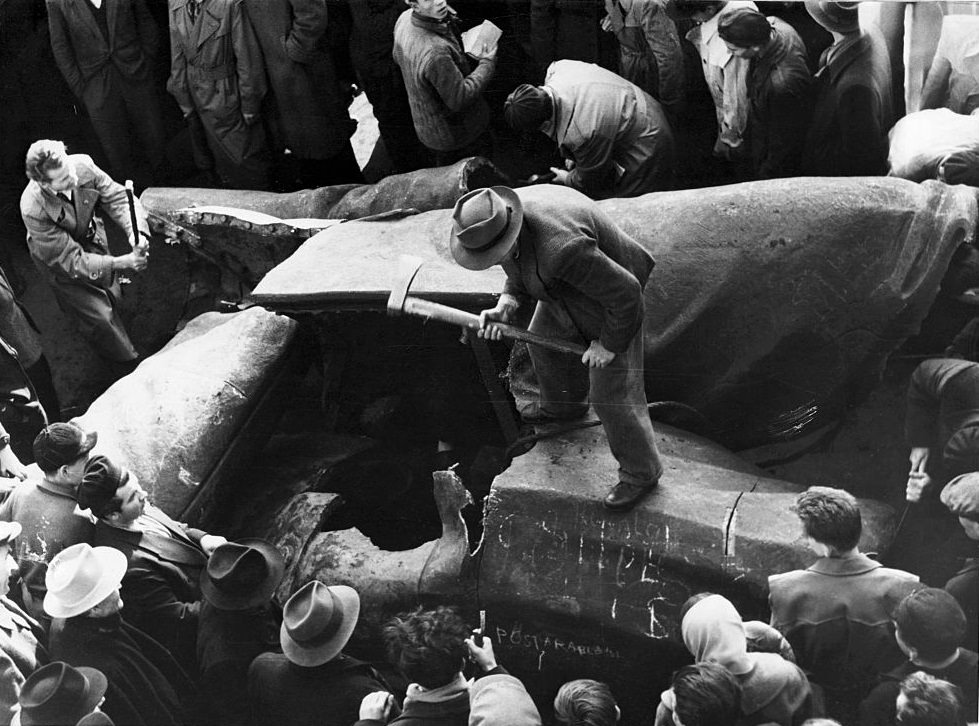
Packed bodies press in from every side as the fallen giant lies across the ground in heavy, broken sections. Men in coats and brimmed hats climb onto the metal mass, swinging tools and prying at seams where the monument has split, while onlookers lean close to witness each strike. The scene is crowded, tense, and physical—an improvised demolition carried out in full view of the street.
Near Budapest’s National Theatre in 1956, the chopping of Stalin’s statue became more than an act of vandalism; it was a public rejection of a political order that had demanded reverence. The photograph lingers on the contrast between the monument’s scale and the ordinary people now reducing it to fragments, turning a symbol of imposed authority into scrap. Even without faces singled out, the collective energy reads clearly: spectators become participants, and participation becomes history.
For readers searching the story of the Hungarian Revolution and the toppling of Soviet-era icons, this image offers a stark, close-up perspective on how regimes are challenged in the physical landscape. It documents the destruction of propaganda as an event in itself—loud, risky, and communal—rather than a quiet afterthought. In a single frame, the cult of personality is rendered vulnerable, and the street becomes the stage where power is dismantled piece by piece.