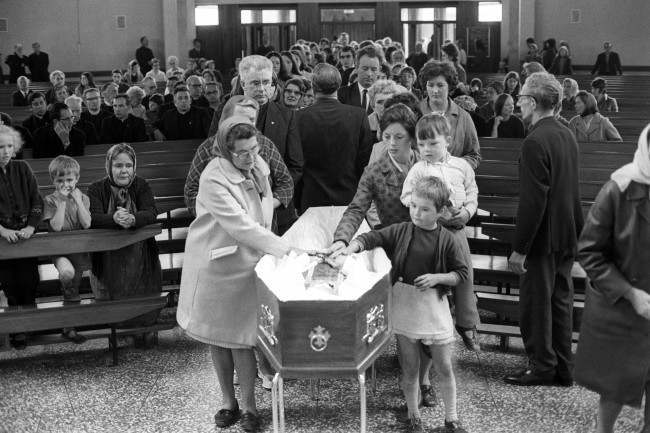
A slow-moving line of mourners fills the nave at Corpus Christi Roman Catholic Church on the Ballymurphy estate, gathering around the coffin of Father Hugh Mullan after Requiem Mass on 11 August 1971. Faces are tight with grief and fatigue, and the quiet rituals of farewell—hands resting on the coffin’s edge, a final touch, a pause before stepping away—carry the weight of a community in shock. In the foreground, women and children stand closest, their expressions unguarded as they take their turn amid the hushed press of bodies.
Rows of wooden pews stretch back into a crowded church interior, where people watch from their seats while others file forward in a steady procession. The composition draws the eye from the coffin outward into the congregation, making the shared nature of mourning unmistakable: this is not a private loss, but a public wound. Details like coats, headscarves, and school-age children underline how widely the tragedy reaches, embedding the scene in everyday life interrupted.
Within the context hinted at by “Civil Wars,” the photograph reads as a stark document of conflict-era bereavement and the role of the Catholic Church as both sanctuary and gathering place. Ballymurphy’s name anchors the story in a specific community, yet the emotions on display resonate far beyond any single parish. For readers searching for the history of Ballymurphy, Father Hugh Mullan, and the funeral rites of 1971, this image offers an intimate glimpse of a society trying to hold itself together through ceremony, solidarity, and remembrance.