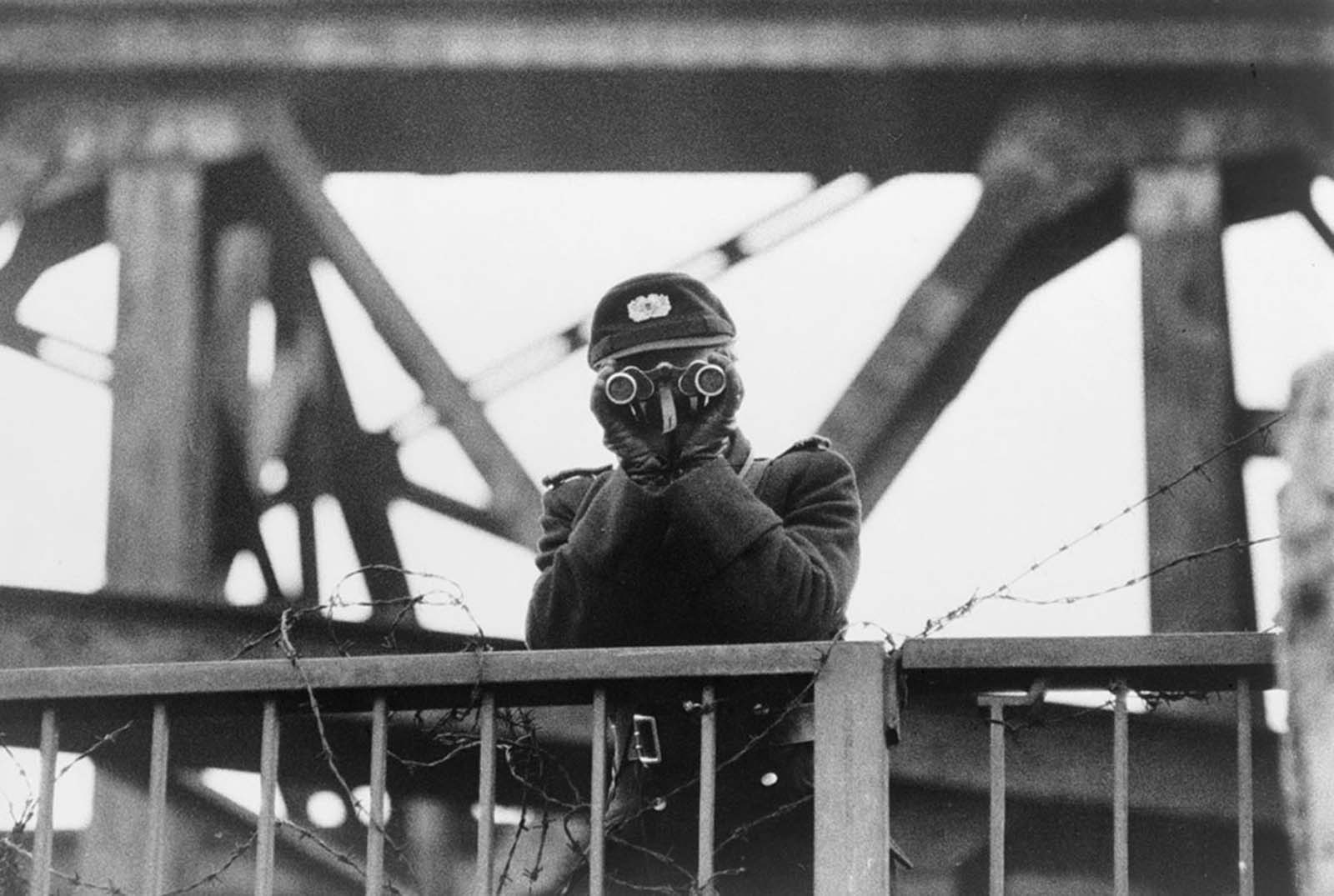
Perched behind a bridge railing strung with barbed wire, an East German VOPO border policeman raises binoculars to his face, turning a routine watch into a symbol of the Cold War’s daily tensions. The steel girders and hard angles of the bridge frame him like a cage, while his heavy coat and gloves hint at long hours spent in the open, scanning for movement and measuring the distance between two political worlds.
In 1961, Berlin’s crossings became pressure points where ideology was enforced not only by walls and fences, but by human eyes and strict orders. The binoculars in the foreground speak to surveillance and suspicion, yet they also suggest the mundane reality of border duty—standing still, observing strangers, and controlling a narrow strip of space where a misstep could carry enormous consequences.
Viewed today, the scene reads as a stark snapshot of East Berlin border security at the moment separation was being tightened and normalized. Details like the wire, the uniform cap, and the guarded posture help anchor the story in the era of divided Berlin, making the photograph a powerful reference for readers searching for historical images of the Berlin Wall period, VOPO police, and the tense bridge links between East and West.