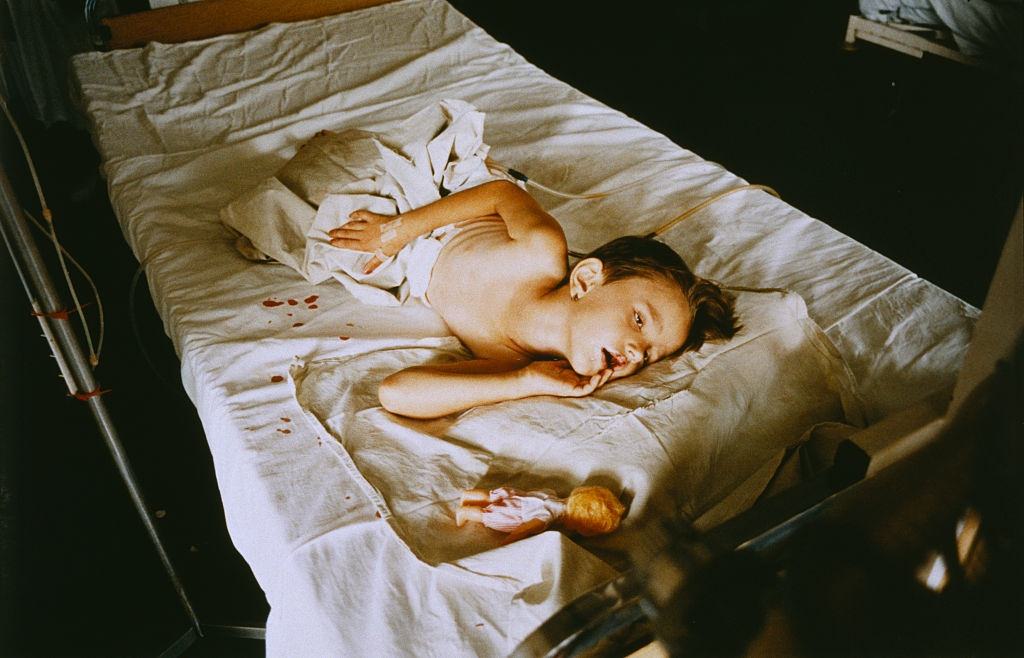
Irma lies on a hospital bed in Sarajevo, her small body turned toward the pillow as if sleep might dull the pain and noise beyond the walls. A few dark stains on the white sheets and the rigidity of her posture hint at injury and recent trauma, while the sparse room offers little comfort beyond clean linen and dim light. The title’s promise of evacuation to London hangs over the scene like a thin thread of hope.
In the broader story of civil wars, it is often the quiet aftermath—waiting, bandaging, and uncertainty—that defines daily life as much as gunfire does. The photograph’s clinical simplicity draws the eye to details that feel painfully intimate: a child’s hand resting near her face, the rumpled cloth at her side, and the sense of vulnerability that no headline can fully convey. Sarajevo here is not a distant place name, but a lived reality reduced to a bedside vigil.
London appears as a destination more than a city, symbolizing medical care, safety, and the international routes that sometimes opened for the wounded. Yet the moment captured is still one of suspension, a pause between harm and help, between a besieged home and an unfamiliar refuge. For readers searching the history of Sarajevo, wartime evacuation, and the human cost of civil war, Irma’s waiting offers a stark, unforgettable entry point.