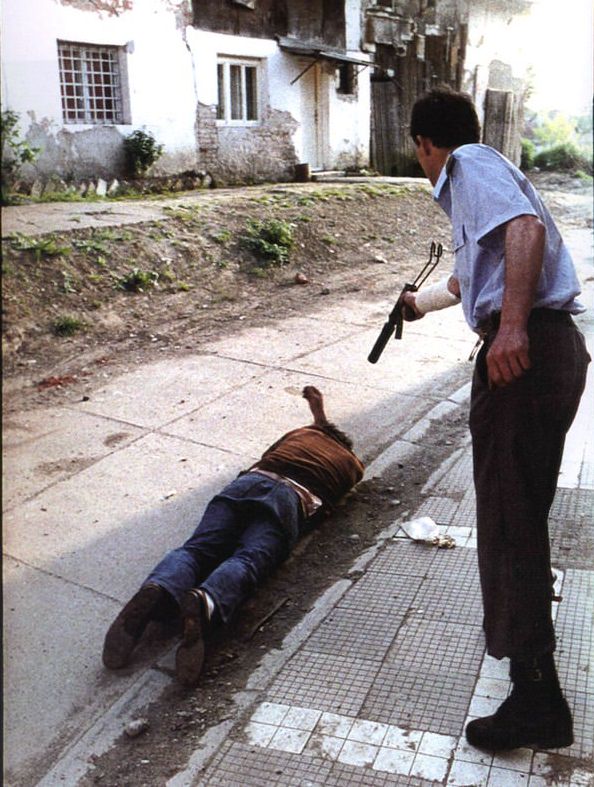
A quiet street in Brčko, Bosnia and Herzegovina becomes the setting for sudden violence, with a uniformed man holding a firearm over a prone victim. The worn pavement, shuttered façades, and ordinary residential details underline how civil wars collapse the boundary between everyday life and terror. In the frame’s stark geometry—sidewalk tiles, curb line, and angled posture—the viewer is confronted with the immediacy of coercion rather than the distant abstraction of conflict.
The title identifies the armed figure as Serb police officer Goran Jelišić, anchoring the scene to the Balkan wars and the mechanisms of power that operated through uniforms, checkpoints, and intimidation. Such images endure because they record not only physical harm but also the imbalance of authority: one person standing, one person forced down, a street turned into a stage for domination. For readers searching terms like Brčko war photo, Bosnia and Herzegovina civil war, or Balkan conflict documentation, this photograph sits among the most unsettling kinds of evidence—direct, unshielded, and difficult to look at.
As a historical source, the picture invites careful reading: the lived-in buildings, the absence of crowds, and the narrow slice of urban space all hint at a community under siege and a social order breaking apart. It also raises ethical questions about witnessing and circulation—what it means to view a victim’s last moments and how such documentation should be contextualized. Placed within a broader discussion of Civil Wars, the image reminds us that the legacy of the conflict is carried not only in treaties and tribunals, but in the lingering detail of a single street where violence was made routine.