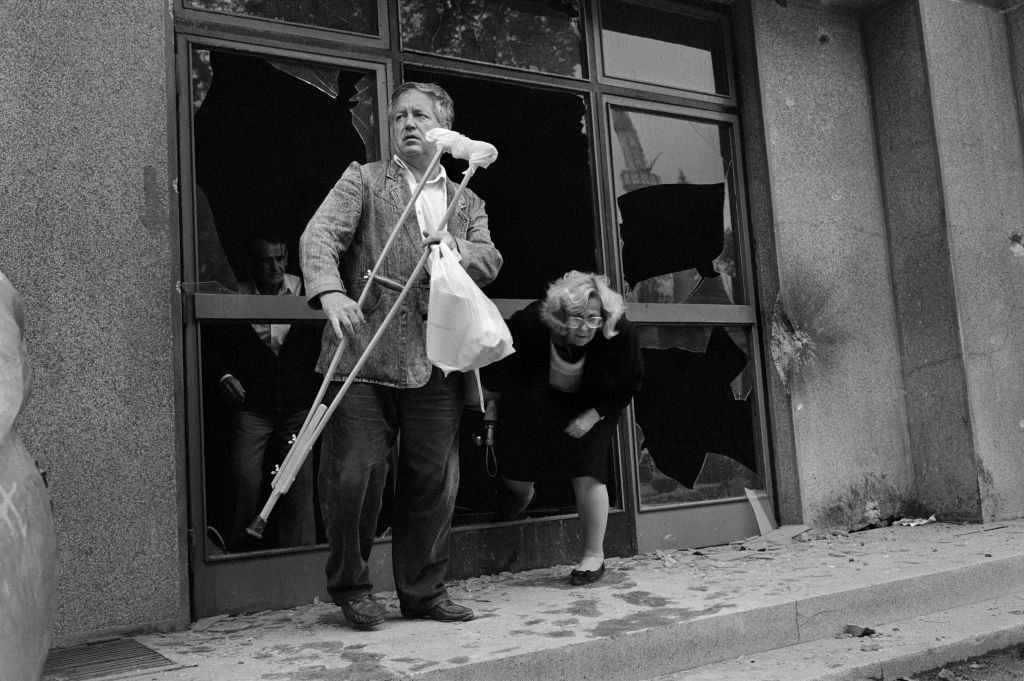
A man stands at the threshold of a shattered storefront, gripping a crutch and a small bag as if both are equally necessary for getting through the day. Behind him, jagged glass frames a dark interior where another figure lingers in the background, half-hidden by the broken panes. The street-level view emphasizes how ordinary errands become precarious when a shop door is no longer usable and the sidewalk is littered with debris.
In the title’s words, this is Sniper Alley in July 1992, and the tension of that setting hangs over every detail. His posture reads as protective and alert, angled outward as he watches the street while waiting for his wife to climb through the damaged window. Her careful movement—stooping, stepping, balancing—turns a simple exit into an obstacle course, a quiet reminder of how conflict reshapes the most routine moments.
Scenes like this anchor the history of civil wars in human scale, where survival is measured in small decisions: when to move, where to step, what to carry. The broken glass and scarred facade act as forensic evidence of violence, but the couple’s coordination speaks to resilience and mutual reliance. For readers searching for photographs of Sniper Alley, July 1992, or the lived experience of urban warfare, this image offers an intimate glimpse of wartime life at a shop window turned into a doorway.