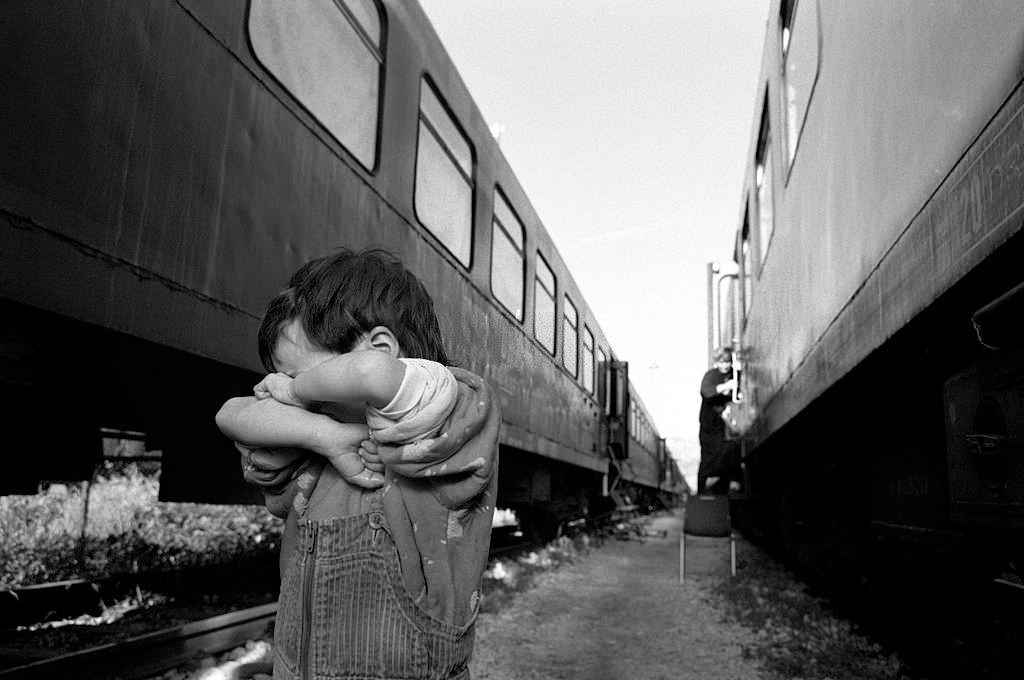
Between two long rows of railway carriages, a small boy folds into himself, arms crossed up to his face as if the camera’s gaze is one more thing to endure. The tracks and gravel corridor stretch away behind him, turning the narrow space into a makeshift street where the usual markers of home—front doors, gardens, familiar corners—have been replaced by steel sides and windowed compartments. His posture says more than words could, capturing the quiet vulnerability of displacement in a refugee camp fashioned from trains.
Along the line of carriages, a figure stands in the mid-distance, half-framed by an open doorway, hinting at daily life continuing within these temporary shelters. The carriages read like stacked rooms on wheels, suggesting a community assembled from necessity during civil wars, where travel has stopped but waiting has not. Light falls hard across metal and dust, emphasizing the starkness of improvised living and the fragile privacy found in such exposed quarters.
What lingers is the tension between movement and confinement: vehicles built for departure turned into stationary housing, and a child who cannot—or will not—meet the lens. For historians and readers interested in refugee history, wartime displacement, and the human cost of civil conflict, the photograph offers a powerful, searchable visual document of survival at the margins. It reminds us that behind big headlines and shifting front lines are small gestures—shyness, fear, exhaustion—that reveal the deeper story.