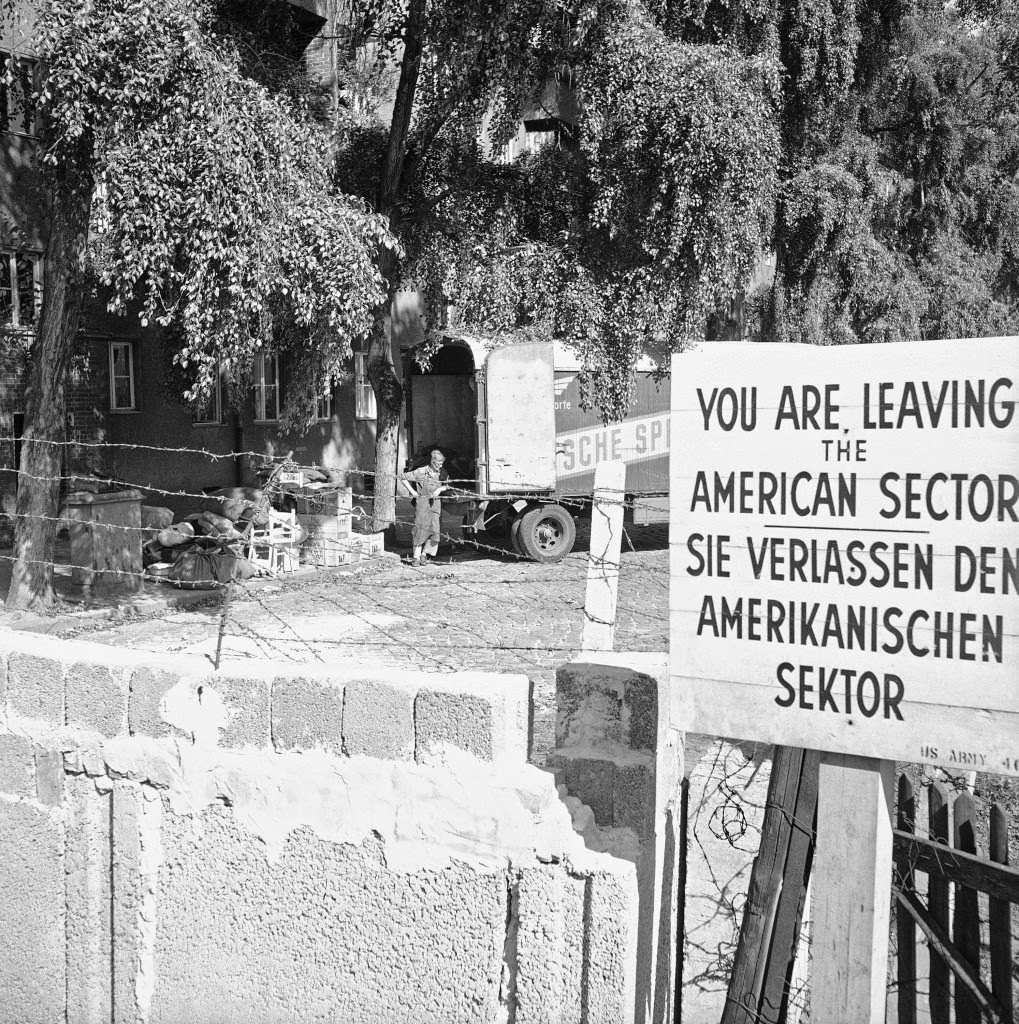
Barbed wire cuts across the foreground, and a rough concrete wall rises like a newly drawn line through everyday life. Beyond it, a moving truck waits under leafy trees while household items—chairs and bundled belongings—sit in a small pile, ready to be taken away. On the right, a stark bilingual sign warns, “YOU ARE LEAVING THE AMERICAN SECTOR / SIE VERLASSEN DEN AMERIKANISCHEN SEKTOR,” turning a simple street corner into an international boundary.
September 20, 1961 comes through in the atmosphere of urgency: not a ceremonial migration, but a practical, heavy task carried out in the shadow of barriers. The title’s reference to east Berliners removing their furniture hints at the human consequences of the Berlin Wall’s sudden hardening—families forced to relocate, possessions gathered quickly, and familiar routines replaced by checkpoints and controlled movement. Even the calm canopy of trees contrasts sharply with the tension of wire, masonry, and watchful signage.
For readers searching Berlin 1961 history, Cold War border photos, or early Berlin Wall scenes, this image offers a grounded view of division—measured not only in geopolitics, but in the weight of everyday objects being loaded and carried away. It reminds us that “civil wars” can also be experienced as quiet domestic upheaval, where a home’s contents become evidence of a life interrupted. In a single frame, the architecture of separation and the logistics of leaving collide, revealing how quickly a city’s streets can become the front line of a divided world.