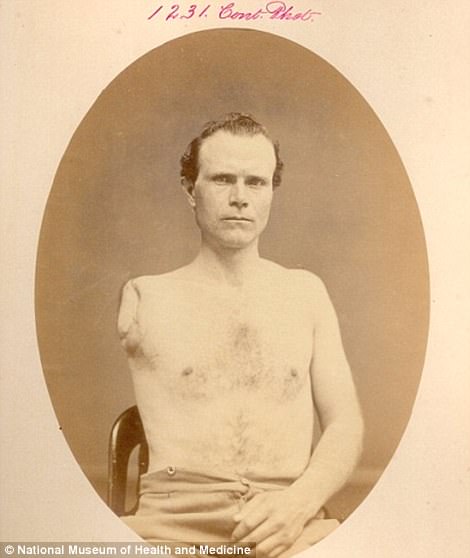
A young veteran sits for the camera with an unguarded directness, his torso bare and his posture carefully arranged to make the injury impossible to miss. The title identifies him as Samuel Irwin of the 67th Pennsylvania Volunteers, and the stark absence of his right arm at the shoulder joint turns the portrait into a plainspoken record of Civil War wounds. Framed in an oval studio mount, the photograph reads less like a keepsake and more like evidence—personal, medical, and historical at once.
Details in the composition hint at the purpose behind the sitting: the simple chair, the neutral backdrop, the clinical clarity of the pose. Yet the human element remains strongest—his face steady, his gaze level, his remaining hand resting with restraint rather than drama. In an era when battlefield trauma was common and surgical amputation often meant survival, such images helped document outcomes and shaped public understanding of the war’s lasting costs.
For readers searching Civil War history, Union volunteer records, or the lived reality of military medicine, Irwin’s portrait offers an unforgettable entry point. It speaks to the experience of wounded soldiers beyond uniforms and battlefields, showing the aftermath carried into studios, hospitals, and homes. The photograph endures as a reminder that the war’s story is written not only in campaigns and commanders, but also in bodies changed forever and in the quiet resilience that followed.