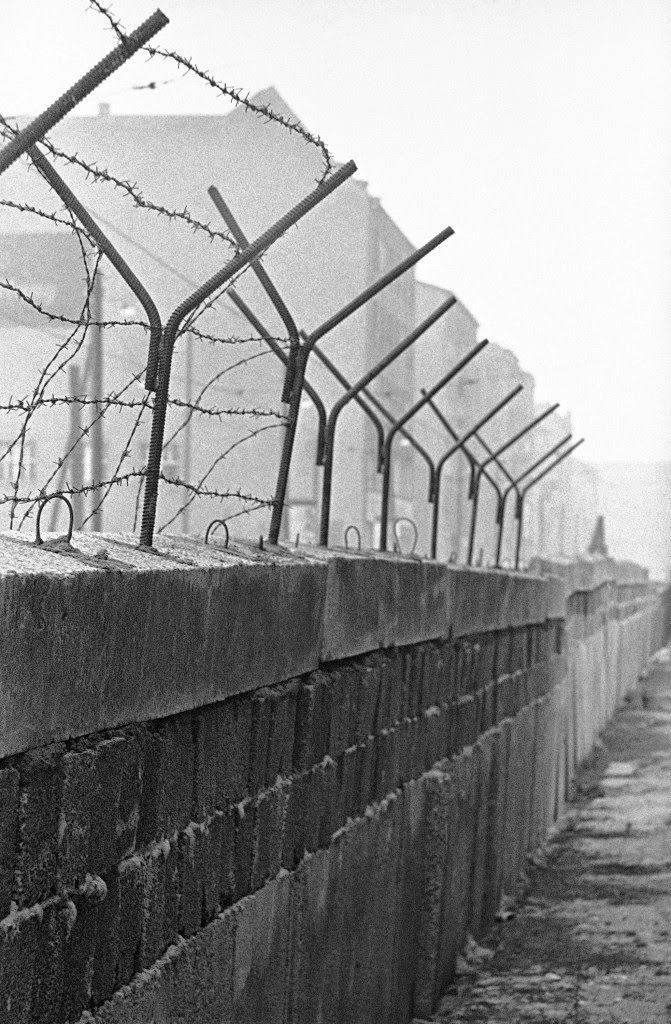
Barbed wire crowns a long run of concrete, the angled metal posts repeating into the distance like a harsh rhythm line. The perspective pulls the eye along the sector border, where the rough texture of the wall and the tangle of wire suggest work done quickly and meant to last. In the hazy background, blocky urban forms fade, reinforcing the sense of a city being reshaped by hard edges and harder decisions.
Dated in the title to Sept. 25, 1961, the scene sits in the tense early phase of the Berlin Wall’s consolidation, when temporary barriers were giving way to reinforced, engineered separation. The foreground’s heavy slabs and the improvised-looking coils of wire speak to escalation—security measures layered one atop another, turning a boundary into a fortress. Even without faces in frame, the photograph implies labor, authority, and the everyday machinery that made Cold War division physical.
Seen today, this East Berlin border image functions as more than documentation; it’s a study in how civil conflict and political fracture can be built into the landscape. The wall’s length and repetition convey permanence, while the empty corridor beside it hints at spaces cleared and lives redirected. For readers searching Berlin Wall history, East Germany border fortifications, or Cold War Berlin photography, the stark details here offer a sober, close-range view of reinforcement at the sector border.