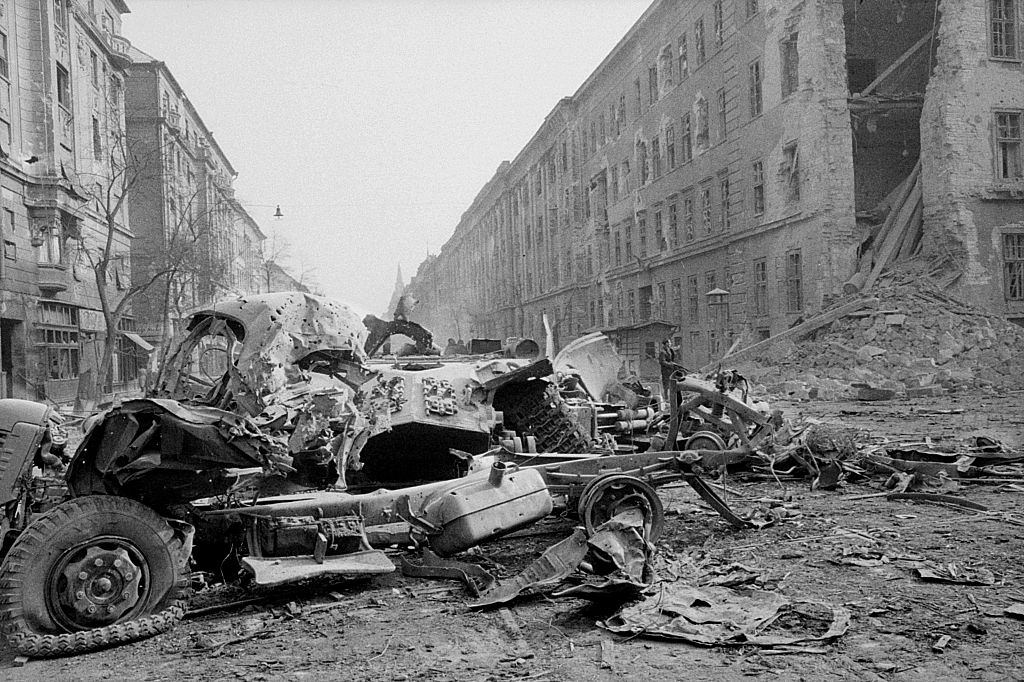
Twisted metal and torn chassis lie strewn across the roadway near the Kilian barracks in Budapest, a grim foreground to a street that has been turned into a corridor of wreckage. The vehicles appear crushed and burned, their frames peeled open as if by sheer force, while scattered parts and debris make the ground uneven and hazardous. Even without people in view, the scene speaks loudly of violence that has only just passed through.
Along both sides of the street, the city’s architecture bears the same story in brick and plaster: façades pocked, windows shattered, and one building’s side wall partially collapsed into a mound of rubble. The long, receding perspective draws the eye toward the hazy distance, where the street narrows into smoke or dust, suggesting how far the destruction extends beyond the camera’s immediate reach. Everyday urban details—doorways, shopfronts, and street fixtures—feel suddenly fragile against the scale of damage.
Dated in the title to 29th October 1956, the photograph anchors these ruins to the Hungarian Revolution of 1956 and the fighting that scarred Budapest’s neighborhoods. It functions as more than a record of destroyed vehicles; it is a quiet inventory of a city’s interrupted routines, where transport, housing, and public space became casualties alongside the people who lived there. For readers searching for historical photos of Budapest 1956, Kilian barracks, and the urban aftermath of civil conflict, this image preserves a stark, unvarnished moment in the capital’s wartime streetscape.