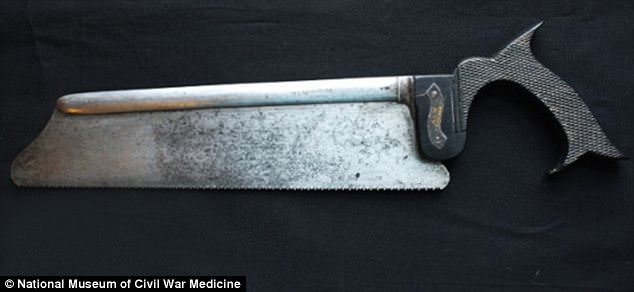
Few artifacts evoke the brutal pragmatism of battlefield medicine like an amputation saw, and the one pictured here is all business: a broad steel blade, a stout ebony-colored handle, and a form built for speed rather than elegance. The surface of the metal bears the dull mottling of age and hard use, while the squared-off profile hints at the deliberate engineering behind a tool meant to bite cleanly through dense bone. Even at rest against a dark backdrop, it carries the heavy atmosphere of triage tents and improvised operating tables.
In Civil War-era surgery, this kind of saw came into play only after the initial cutting of skin and muscle, when saving a life often meant sacrificing a limb before infection or shock claimed the patient. Surgeons depended on sharp teeth, a stable grip, and a decisive stroke—qualities suggested by the saw’s thick spine and pistol-style handle designed to control force at close quarters. Seen up close, the object reads less like a curiosity and more like a reminder of how medicine advanced under pressure, one grim necessity at a time.
For readers exploring Civil War history, medical tools, and the evolution of surgery, the image offers a stark entry point into the realities behind casualty numbers and campaign maps. It invites questions about anesthesia, sanitation, hospital organization, and the human cost of war—topics that still shape how we interpret military conflict and public health today. As a historical photo, it’s a powerful, SEO-friendly touchstone for posts about Civil War medicine, surgical instruments, and the lived experience of wartime care.