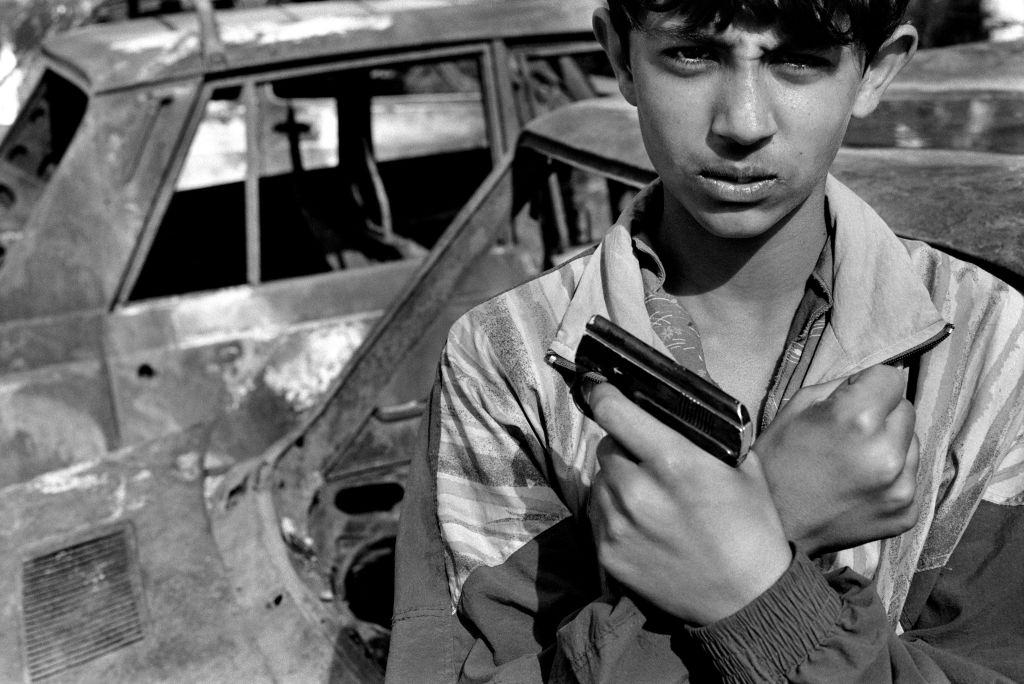
A boy stands close to the lens with his arms crossed, gripping a small automatic pistol against his jacket, his expression tightened into a hard, watchful stare. Behind him, wrecked cars sit with shattered windows and crumpled metal, turning an everyday street scene into evidence of violence. The tight framing and stark light pull attention to the uneasy contrast between youth and weapon, innocence and immediate danger, that defined so many frontline suburbs during civil wars.
The destroyed vehicles in the background read like a catalogue of disruption—private lives abruptly halted, mobility reduced to rust and broken glass. No banners or landmarks announce a specific place, yet the setting feels familiar in the way conflict makes neighborhoods interchangeable: a curbside becomes cover, a parked car becomes a husk, and public space turns suspicious. In 1992, images like this circulated widely because they distilled complex political collapse into a single, unsettling portrait.
Seen today, the photograph works as more than reportage; it is a reminder of how quickly war can recruit symbols, gestures, and even children into its logic. The pistol is small, but its presence dominates, reshaping the boy’s posture and the viewer’s response. For readers searching for historical war photography, civil war memory, or the human cost of urban fighting, this portrait offers a raw entry point into the atmosphere of a city’s edge under strain.