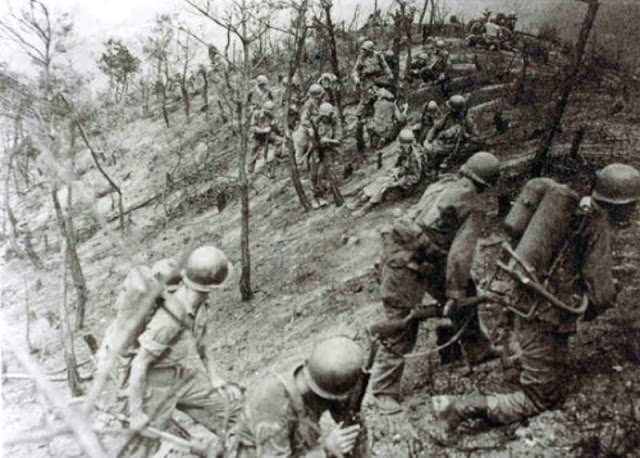
Across a scraped hillside of bare trees and churned earth, American troops move in a tight file, helmets low and bodies angled for cover. Several soldiers carry the unmistakable bulk of flamethrower gear—twin fuel cylinders and hoses strapped to their backs—marking them as a specialized assault element rather than ordinary infantry. The terrain looks raw and exposed, suggesting recent shelling or burning, with little vegetation left to hide a careful advance.
The title points to a tunnel entrance ahead, and the composition reinforces that sense of an objective just out of frame: men climb and crouch in staggered positions, scanning the slope while keeping momentum. Flamethrower units were often used where defenders could disappear into earthworks, caves, or fortified openings, and the equipment’s weight seems to dictate the deliberate pace. Even without a visible blast, the photograph communicates the strain of carrying volatile fuel into close quarters, where a few yards can decide everything.
For readers interested in 1950s-era combat photography, this scene offers a stark look at how U.S. forces approached fortified positions during mid‑century conflicts. Details like web gear, steel helmets, and the bulky flame apparatus help situate the image within Cold War battlefields and the tactical problem of fighting an enemy entrenched underground. It’s a reminder that war was not only fought across open ground, but also at the mouths of tunnels—spaces where fear, training, and fire converged.