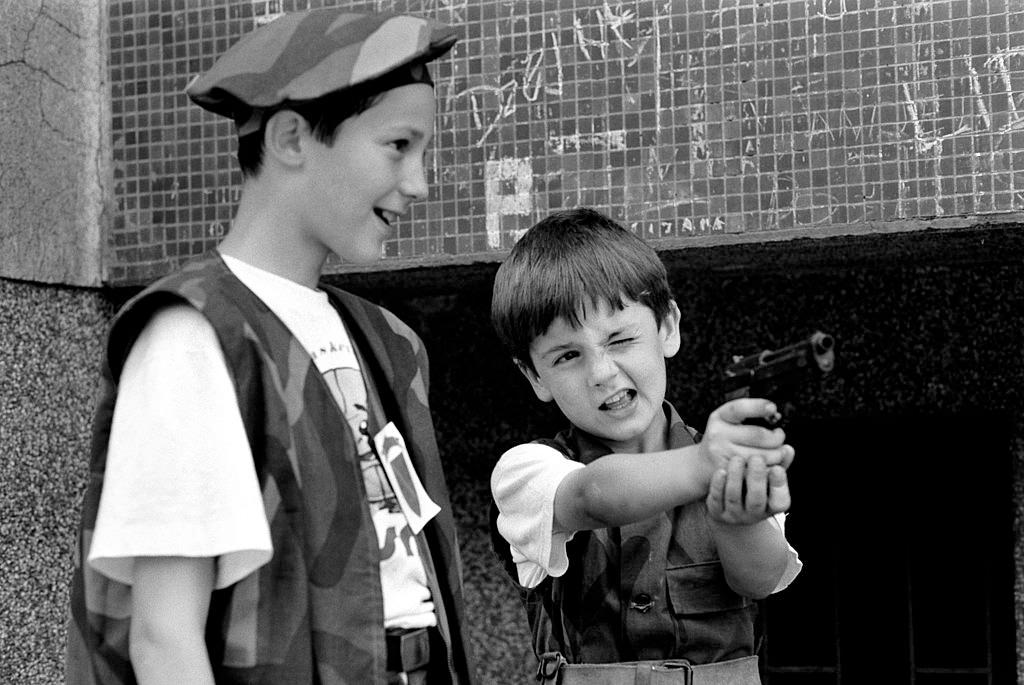
Against a rough wall and a gridded window, two boys wear oversized camouflage-style uniforms that mimic the look of Bosnian army fighters. One smiles broadly, half-turned toward his friend, while the other squints with concentration as he extends his arms to aim a real pistol. The contrast between childlike faces and military trappings makes the scene feel both ordinary and deeply unsettling.
War has a way of leaking into everyday life, and in civil wars the boundary between play and survival can blur with frightening speed. Here, childhood improvisation borrows the symbols of armed conflict—caps, vests, a stance copied from adult fighters—until the costume becomes something more literal. The weapon’s presence changes the photograph’s meaning entirely, turning a moment of mimicry into a stark reminder of how easily violence becomes normalized.
For readers exploring Bosnia, civil war photography, and the social history of conflict, this image offers a compressed story about militarization and innocence. It invites questions rather than easy conclusions: where did the pistol come from, what did these boys see before this moment, and how did the world around them shape their games? As a historical photo, it lingers because it shows not a battlefield, but a childhood reshaped by war’s proximity.