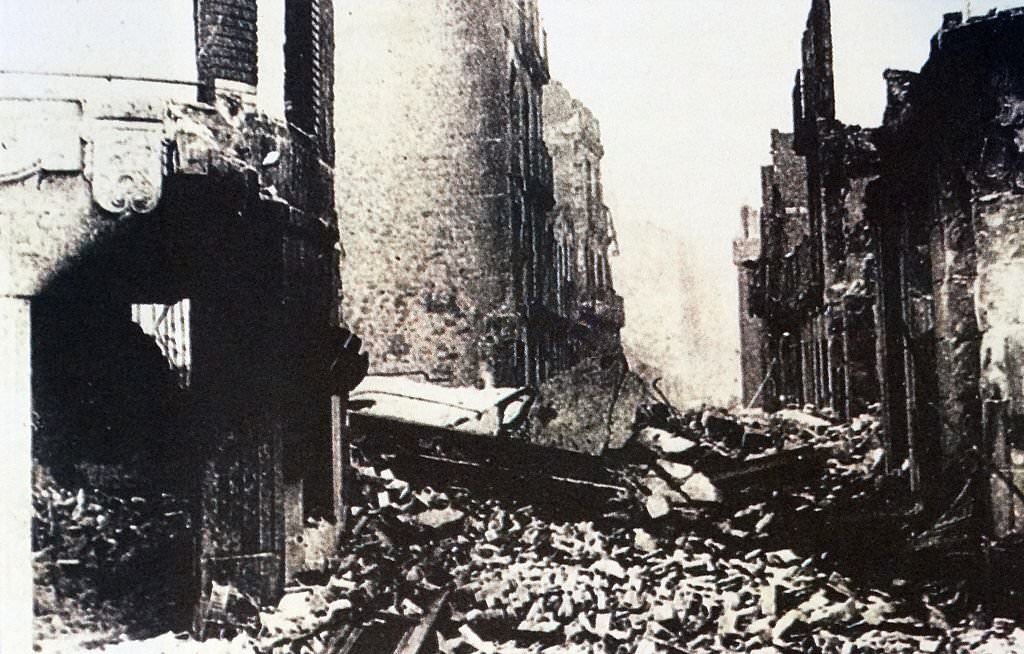
Rubble fills a narrow street in Guernica, where shattered masonry and broken beams spill outward from hollowed buildings. Jagged facades stand like torn pages, their windows erased and walls blackened, while the roadway disappears under a rough carpet of debris. The stark emptiness—no traffic, no ordinary movement—underscores the suddenness with which everyday urban life can be reduced to ruins.
Seen through the lens of civil war, the scene speaks to the air raid attack on the Basque town of Guernica, Spain, and the grim evolution of modern warfare. Bombing did not merely damage structures; it unmade neighborhoods, left interiors exposed to the sky, and turned familiar streets into dangerous, impassable corridors. The photograph’s harsh contrasts emphasize collapsed load-bearing walls and partially standing shells, offering a visual record of destruction that words struggle to match.
For readers exploring the Spanish Civil War and the history of aerial bombardment, this image serves as a sobering reference point for what “air raid” meant on the ground. The ruined architecture and dust-choked street invite closer attention to details—cracked stonework, fallen timbers, and the precarious angles of remaining walls—that anchor the event in tangible evidence. It remains a powerful historical photo of Guernica, useful for understanding how attacks on towns reverberate far beyond the battlefield.